AI-powered resume screening is transforming the recruitment industry by helping companies filter and evaluate candidates faster through automation and data-driven hiring systems. In 2026, businesses increasingly use applicant tracking systems (ATS) and AI recruitment tools to manage large volumes of applications and improve hiring efficiency for fresher roles. AI-powered resume screening is becoming increasingly important because companies now use AI hiring systems and resume screening automation to improve fresher recruitment efficiency.
Modern recruitment systems now analyze:
- Resume keywords
- Skill relevance
- Experience matching
- Educational background
- ATS-friendly formatting
These technologies help recruiters shortlist candidates more efficiently while reducing manual screening time. Many businesses now depend on AI-powered resume screening tools to manage fresher hiring trends in 2026 more effectively. AI-powered resume screening is becoming one of the most important technologies in modern recruitment systems.
Another major shift is the growing importance of resume optimization and practical skill visibility. Freshers can no longer depend only on basic resumes because AI-driven systems increasingly prioritize clear formatting, relevant keywords, practical projects, certifications, and industry-focused skills. At the same time, human recruiters still evaluate communication, problem-solving ability, and cultural fit during final hiring stages. In the upcoming sections, we will discuss how AI-powered resume screening is changing fresher hiring in 2026, how applicant tracking systems and recruitment automation influence hiring decisions, and which resume optimization strategies help freshers improve visibility, interview opportunities, and long-term career growth. AI-Powered Resume Screening Is Changing Fresher Hiring in 2026
H2: Why AI-Powered Resume Screening Is Becoming Common in Recruitment
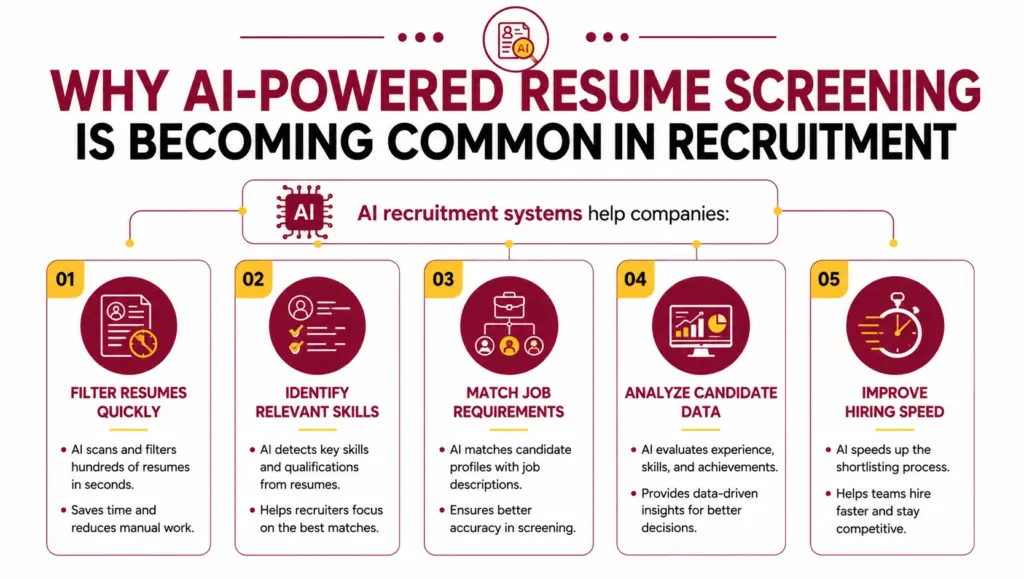
AI-powered resume screening is becoming common because companies receive large numbers of applications for fresher roles and need faster ways to identify relevant candidates. In 2026, businesses increasingly use automation and AI-driven recruitment systems to improve hiring efficiency and reduce manual screening workloads. Many recruiters now depend on AI-powered resume screening to improve fresher hiring efficiency and resume evaluation speed.
AI recruitment systems help companies:
- Filter resumes quickly
- Identify relevant skills
- Match job requirements
- Analyze candidate data
- Improve hiring speed
These systems make large-scale recruitment more manageable.
Another major advantage is recruitment analytics. AI-powered tools can evaluate:
- Resume keywords
- Experience relevance
- Educational background
- Skill alignment
- ATS compatibility
This helps recruiters shortlist candidates more efficiently.
AI-driven screening also improves:
- Hiring consistency
- Candidate filtering accuracy
- Workflow automation
- Recruitment scalability
- Initial evaluation processes
Companies can process thousands of applications more effectively using automated systems. AI-Powered Resume Screening Is Changing Fresher Hiring in 2026
However, AI screening systems still depend heavily on resume quality and optimization. Poor formatting, missing keywords, or weak skill presentation may reduce visibility even if candidates have relevant abilities. AI-powered resume screening helps companies filter applications faster through automation-driven hiring workflows.
Businesses also increasingly combine:
- AI-assisted screening
- Recruitment analytics
- Human interviews
- Skill evaluations
- Communication assessments
to improve overall hiring decisions.
For learners exploring modern AI resume screening systems, understanding recruitment automation and ATS workflows is becoming highly important for fresher hiring success in 2026. The AI recruitment process also improves resume screening automation by helping recruiters identify qualified candidates faster through ATS-based filtering systems.
H2: ATS-Friendly Resumes Improve Fresher Hiring Opportunities
ATS-friendly resumes are becoming highly important because many companies now use applicant tracking systems to filter applications before recruiters manually review them. In 2026, freshers with properly optimized resumes often improve their chances of getting shortlisted for interviews.
An ATS-friendly resume usually focuses on:
- Clear formatting
- Relevant keywords
- Structured headings
- Skill-focused content
- Simple design layouts
These elements help AI systems scan resumes more effectively.
Another important factor is keyword optimization. Recruitment systems often analyze resumes based on:
- Job-specific skills
- Technical keywords
- Industry terms
- Certifications
- Relevant tools
Including relevant keywords improves resume matching and visibility.
An ATS-friendly resume usually focuses on:
- Clear formatting
- Relevant keywords
- Structured headings
- Skill-focused content
- Simple design layouts
These elements help AI systems scan resumes more effectively.
Another important factor is keyword optimization. Recruitment systems often analyze resumes based on:
- Job-specific skills
- Technical keywords
- Industry terms
- Certifications
- Relevant tools
Including relevant keywords improves resume matching and visibility.
Table 1: Resume Optimization Strategy vs Hiring Benefit
| Resume Optimization Strategy | Hiring Benefit |
| ATS-Friendly Formatting | Better resume visibility |
| Keyword Optimization | Improved recruiter matching |
| Skill-Based Resume Structure | Higher shortlisting chances |
| Clear Project Experience | Better fresher evaluation |
Freshers should also highlight:
- Practical projectsInternship experience
- Certifications
- Portfolio links
- Industry-relevant skills
- These details improve recruiter confidence during shortlisting.
- Many candidates make the mistake of using overly designed resumes with:
- Complex graphics
- Unreadable layouts
- Excessive icons
- Poor formatting
- Missing keywords
- Such designs may reduce ATS compatibility.
- For students exploring modern recruitment automation tools, learning ATS-friendly resume optimization strategies can significantly improve fresher hiring opportunities in 2026.
H2: Recruitment Analytics and AI Filtering Are Changing Hiring Decisions
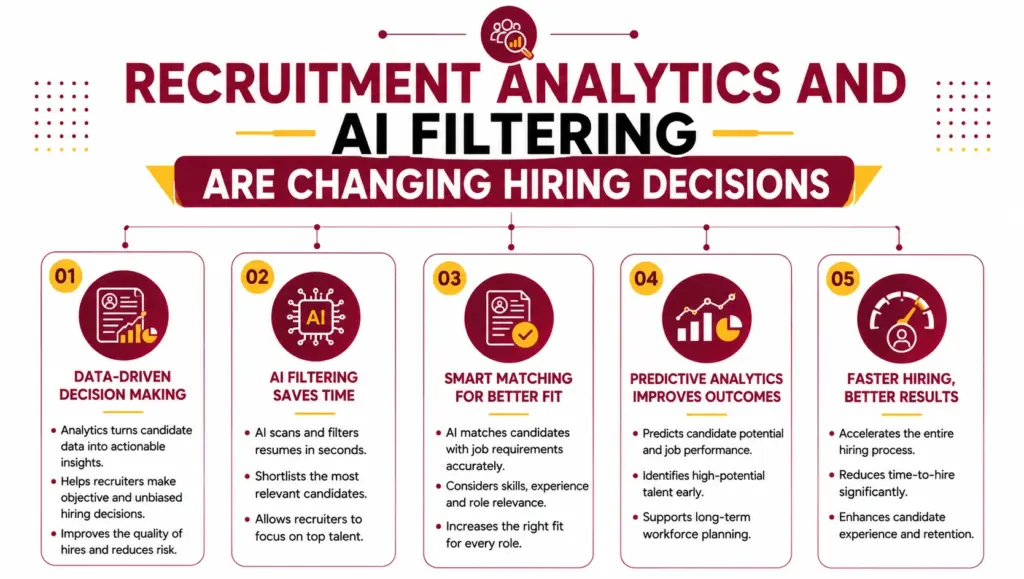
Recruitment analytics and AI filtering systems are changing hiring decisions by helping companies evaluate candidates using data-driven processes. In 2026, businesses increasingly depend on recruitment technology to improve hiring accuracy, reduce screening time, and identify suitable fresher candidates more efficiently.
AI-powered recruitment systems analyze:
- Resume relevance
- Skill matching
- Keyword alignment
- Educational qualifications
- Experience indicators
These insights help recruiters shortlist applications faster.
Another important advantage is hiring efficiency. Recruitment analytics supports:
- Faster candidate filtering
- Improved shortlisting
- Automated evaluation workflows
- Large-scale recruitment handling
- Better hiring consistency
This reduces manual workload for recruitment teams.
AI filtering systems also help businesses identify candidates with:
- Relevant technical skills
- Industry certifications
- Project experience
- Internship exposure
- ATS-optimized resumes
As a result, resume structure and content quality are becoming highly important.
Freshers should focus on building resumes that clearly highlight:
- Skills
- Projects
- Certifications
- Practical learning
- Career-focused achievements
Well-structured resumes improve both AI visibility and recruiter understanding.
For students preparing professional resumes through this online resume builder, understanding recruitment analytics and AI filtering systems can significantly improve fresher hiring opportunities in 2026. AI-powered resume screening systems also improve candidate shortlisting and recruitment consistency for HR teams.
H2: Human Recruiters Still Play an Important Role in Hiring
Even though AI-powered recruitment systems are improving automation and resume filtering, human recruiters still play an important role in hiring decisions. In 2026, companies continue depending on recruiters to evaluate communication, personality, problem-solving ability, and overall candidate suitability beyond resume analysis. AI-Powered Resume Screening Is Changing Fresher Hiring in 2026
AI systems help recruiters by handling:
- Resume screening
- Keyword matching
- Candidate filtering
- Initial shortlisting
- Recruitment analytics
However, final hiring decisions usually involve human evaluation.
Recruiters often assess candidates based on:
- Communication skills
- Confidence levels
- Practical understanding
- Cultural fit
- Team collaboration ability
These qualities cannot be fully measured through automated systems alone.
Another important reason human recruiters remain valuable is because hiring often requires:
- Personalized interaction
- Interview judgment
- Behavioral assessment
- Situation-based evaluation
- Career potential analysis
Human decision-making continues influencing fresher recruitment outcomes.
H3: Which Fresher Skills Will Become More Important in 2026?
As AI-driven hiring systems continue growing, freshers should focus on developing both technical and professional skills.
Important fresher skills include:
- Communication skills
- Practical project experience
- AI tool awareness
- Problem-solving ability
- Analytics understanding
- Industry-focused learning
Candidates who combine technical skills with communication and practical implementation are often better prepared for future hiring opportunities.
H2: Resume Optimization and Practical Skills Improve Selection Chances
Resume optimization and practical skills are becoming highly important because companies increasingly prefer candidates who demonstrate real-world capabilities instead of only academic qualifications. In 2026, freshers with strong resumes, practical projects, and industry-relevant skills often improve their chances of getting shortlisted. Companies increasingly use AI-powered resume screening because it supports faster recruitment and better skill matching. AI-Powered Resume Screening Is Changing Fresher Hiring in 2026
An optimized resume should clearly highlight:
- Technical skills
- Internship experience
- Certifications
- Project work
- Industry tools knowledge
These elements help recruiters quickly understand candidate strengths.
Another major factor is practical implementation. Recruiters increasingly value candidates with:
- Portfolio projects
- Hands-on learning
- Campaign experience
- Real-world assignments
- Practical problem-solving ability
This improves confidence during hiring evaluations.
Table 2: Recruitment Technology Trend vs Hiring Impact
| Recruitment Technology Trend | Hiring Impact |
| AI Resume Screening | Faster shortlisting |
| ATS Optimization | Better candidate visibility |
| Recruitment Analytics | Improved hiring accuracy |
| Skill-Based Evaluation | Better fresher assessment |
Industry-relevant certifications also support fresher hiring because they help validate:
- Technical knowledge
- Practical understanding
- Tool familiarity
- Workflow awareness
- Career-focused learning
Recruiters often prefer candidates who continuously improve their skills.
Freshers should also focus on maintaining:
- Clear resume formatting
- Updated project details
- Relevant keywords
- Professional communication
- Practical learning exposure
These factors improve both ATS compatibility and recruiter evaluation.
For learners exploring recruitment trends hiring datasets and trends, resume optimization and practical skill development continue playing a major role in fresher hiring success in 2026. AI-powered resume screening tools are transforming fresher hiring trends in 2026 through ATS-based recruitment technologies.
H2: Common Mistakes Freshers Make While Applying for Jobs
Many freshers struggle during job applications because they submit generic resumes without understanding how modern recruitment systems evaluate candidates. In 2026, AI-powered hiring systems and recruiters both expect resumes that clearly highlight relevant skills, practical experience, and industry-focused learning. AI-Powered Resume Screening Is Changing Fresher Hiring in 2026
One common mistake is using generic resumes for every application. Many candidates apply without customizing:
- Resume keywords
- Skill sections
- Project descriptions
- Career objectives
- Role-specific content
This reduces relevance and ATS matching accuracy.
Another major issue is poor resume formatting. Some freshers use:
- Complex graphics
- Overdesigned layouts
- Unclear structure
- Excessive icons
- Difficult formatting
These elements may reduce ATS compatibility and recruiter readability.
Many candidates also ignore practical skill visibility. Recruiters increasingly prefer freshers with:
- Portfolio projects
- Internship exposure
- Practical assignments
- Industry certifications
- Tool-based learning
Without these experiences, resumes may appear weak compared to other applicants.
Freshers should also avoid:
- Spelling mistakes
- Weak communication
- Missing keywords
- Irrelevant information
- Applying without preparation
Small mistakes can significantly affect shortlisting opportunities.
For students exploring inspiring student placement success stories, understanding resume quality, practical implementation, and hiring expectations can help improve fresher job opportunities in 2026. Modern AI hiring systems rely heavily on AI-powered resume screening to identify relevant skills and qualifications. AI-Powered Resume Screening Is Changing Fresher Hiring in 2026
H2: How Students Can Prepare for AI-Driven Hiring Systems
Preparing for AI-driven hiring systems in 2026 requires students to focus on resume optimization, practical skill development, communication abilities, and industry-focused learning. Since many companies now use AI-assisted recruitment workflows, freshers should understand how automated systems evaluate applications before interviews.
One of the most important preparation steps is building an ATS-friendly resume with:
- Clear formatting
- Relevant keywords
- Skill-focused sections
- Project experience
- Industry certifications
This improves visibility during AI-powered screening.
Students should also focus on practical learning through:
- Internship projects
- Portfolio development
- Real-world assignments
- Industry tools practice
- Hands-on implementation
Practical exposure improves recruiter confidence and hiring readiness.
Another important area is communication and interview preparation because human recruiters still evaluate:
- Confidence
- Problem-solving ability
- Team collaboration
- Communication clarity
- Professional attitude
Strong soft skills continue playing an important role during hiring.
Students should also stay updated with:
- AI recruitment trends
- ATS optimization strategies
- Industry skill requirements
- Automation technologies
- Digital hiring workflows
Continuous learning helps improve long-term career opportunities. AI-Powered Resume Screening Is Changing Fresher Hiring in 2026
Freshers who combine technical skills, practical experience, ATS-friendly resume building, and communication abilities are generally better prepared for future AI-driven hiring environments. AI-powered resume screening is helping companies improve fresher hiring efficiency through automation and ATS-based recruitment systems.
Preparing for AI-driven hiring systems in 2026 requires students to focus on resume optimization, practical skill development, communication abilities, and industry-focused learning. Since many companies now use AI-assisted recruitment workflows, freshers should understand how automated systems evaluate applications before interviews.
One of the most important preparation steps is building an ATS-friendly resume with:
- Clear formatting
- Relevant keywords
- Skill-focused sections
- Project experience
- Industry certifications
This improves visibility during AI-powered screening.
Students should also focus on practical learning through:
- Internship projects
- Portfolio development
- Real-world assignments
- Industry tools practice
- Hands-on implementation
Practical exposure improves recruiter confidence and hiring readiness.
Another important area is communication and interview preparation because human recruiters still evaluate:
- Confidence
- Problem-solving ability
- Team collaboration
- Communication clarity
- Professional attitude
Strong soft skills continue playing an important role during hiring.
Students should also stay updated with:
- AI recruitment trends
- ATS optimization strategies
- Industry skill requirements
- Automation technologies
- Digital hiring workflows
Continuous learning helps improve long-term career opportunities.
Freshers who combine technical skills, practical experience, ATS-friendly resume building, and communication abilities are generally better prepared for future AI-driven hiring environments.
Final Thoughts
AI-powered recruitment systems are rapidly transforming fresher hiring by improving resume screening, recruitment analytics, and hiring automation. In 2026, companies increasingly depend on ATS platforms and AI-assisted evaluation systems to manage large-scale recruitment and identify suitable candidates more efficiently. AI-powered resume screening continues transforming modern hiring because companies increasingly prefer automation-driven recruitment systems for fresher hiring in 2026.
At the same time, resume optimization, practical skills, certifications, and project experience are becoming highly important for freshers. Candidates who understand ATS-friendly resume strategies and industry-focused skill development often improve their chances of getting shortlisted and securing interviews.
Even as recruitment automation continues growing, human recruiters still play an important role in evaluating communication, confidence, and practical understanding. Students who combine technical knowledge, practical learning, professional communication, and AI-aware job preparation will be better prepared for future hiring opportunities and long-term career growth.
Build Industry-Ready Skills for AI-Driven Hiring Opportunities
AI-powered recruitment systems are changing how companies shortlist and evaluate fresher candidates through ATS platforms, automation workflows, and data-driven hiring processes. Businesses now look for candidates who combine technical skills, practical experience, communication abilities, and industry-ready project exposure.
Preparing for future hiring opportunities requires more than academic qualifications. Students should focus on ATS-friendly resume building, practical implementation, portfolio development, interview preparation, and continuous skill improvement to stay competitive in evolving recruitment environments.
To improve fresher hiring opportunities in 2026, learners should focus on:
- Resume optimization
- Practical project experience
- Industry certifications
- Communication skills
- AI-aware job preparation
- Portfolio development
If you want to build industry-ready expertise with practical learning exposure and future-focused career preparation, this AI-powered digital marketing training can help support your journey toward long-term success in AI-driven hiring environments and digital marketing careers.
FAQ 1: What is AI-powered resume screening?
AI-powered resume screening is the use of artificial intelligence and automation systems to filter, analyze, and shortlist resumes during recruitment processes.
FAQ 2: Why are companies using AI recruitment systems in 2026?
Companies use AI recruitment systems to improve hiring speed, automate resume filtering, reduce manual workload, and manage large volumes of applications more efficiently.
FAQ 3: What is an ATS-friendly resume?
An ATS-friendly resume is a resume designed with simple formatting, relevant keywords, and structured sections that can be easily scanned by applicant tracking systems.
FAQ 4: Why is keyword optimization important in resumes?
Keyword optimization helps AI recruitment systems identify relevant skills, certifications, tools, and experience that match job descriptions and hiring requirements.
FAQ 5: How do AI hiring systems evaluate resumes?
I hiring systems commonly analyze:
- Resume keywords
- Skill relevance
- Educational background
- Experience matching
- ATS compatibility
These factors influence shortlisting decisions.
FAQ 6: Will AI completely replace human recruiters?
No. Human recruiters still play an important role in evaluating communication skills, confidence, cultural fit, practical understanding, and interview performance.
FAQ 7: What practical skills improve fresher hiring opportunities?
Important practical skills include:
- Project implementation
- Portfolio development
- Industry tools knowledge
- Communication skills
- Internship experience
- Problem-solving ability
These skills improve recruiter confidence.
FAQ 8: What common mistakes should freshers avoid while applying for jobs?
Common mistakes include:
- Poor resume formatting
- Weak keyword usage
- Generic resumes
- Lack of project experience
- Spelling mistakes
Avoiding these issues improves hiring visibility.
FAQ 9: How can students prepare for AI-driven hiring systems?
Students can prepare by building ATS-friendly resumes, developing practical skills, creating portfolios, improving communication abilities, and learning industry-relevant technologies.
FAQ 10: What is the future of AI-powered recruitment?
AI-powered recruitment is expected to continue growing through automation, recruitment analytics, ATS optimization, skill-based evaluation, and AI-assisted hiring workflows in the coming years.
Leave a Reply