Author: Lathaaganesh

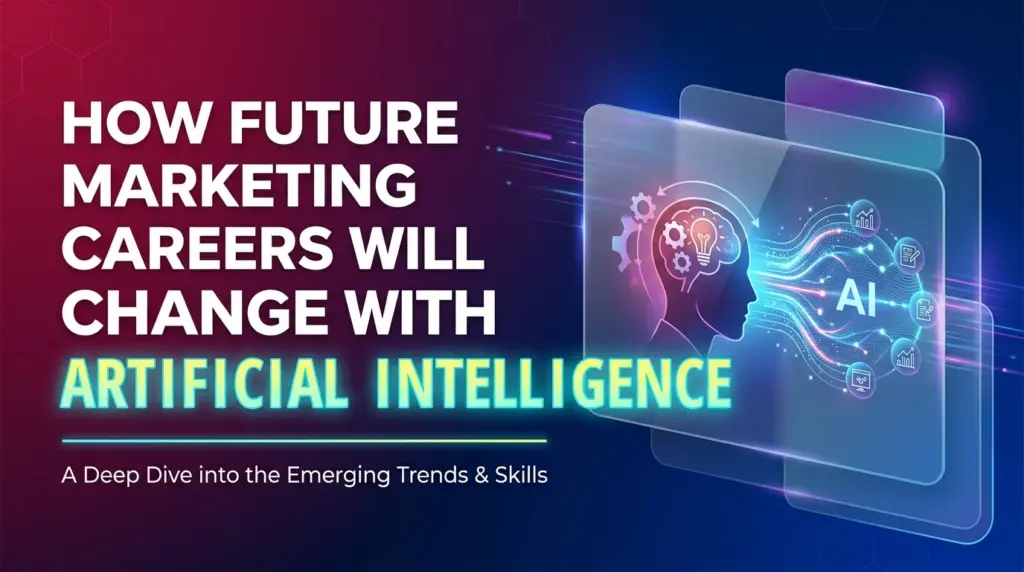
  • How Future Marketing Careers Will Change With Artificial Intelligence

    Artificial intelligence is rapidly transforming the digital marketing industry by changing how businesses manage campaigns, analyze customer behavior, create content, and automate workflows. In 2026, companies increasingly depend on AI-powered systems to improve productivity, personalization, analytics, and customer engagement across multiple digital platforms.

    Businesses now use AI for:

    • Content optimization
    • Marketing automation
    • Predictive analytics
    • Customer personalization
    • Audience targeting

    These technologies are reshaping traditional marketing roles and creating new career opportunities focused on AI-assisted workflows and data-driven strategies.

    Another major shift is the growing importance of human + AI collaboration. While automation handles repetitive tasks and large-scale data analysis, marketers still play an important role in creativity, communication, storytelling, strategy, and audience understanding. Future marketing careers will increasingly require professionals who can combine technical AI knowledge with human-centered marketing skills. In the upcoming sections, we will discuss how future marketing careers will change with artificial intelligence, which AI-powered marketing skills are becoming important in 2026, and how students and professionals can prepare for evolving digital marketing opportunities driven by automation, analytics, and AI-assisted workflows.

    Why Artificial Intelligence Is Transforming Marketing Careers
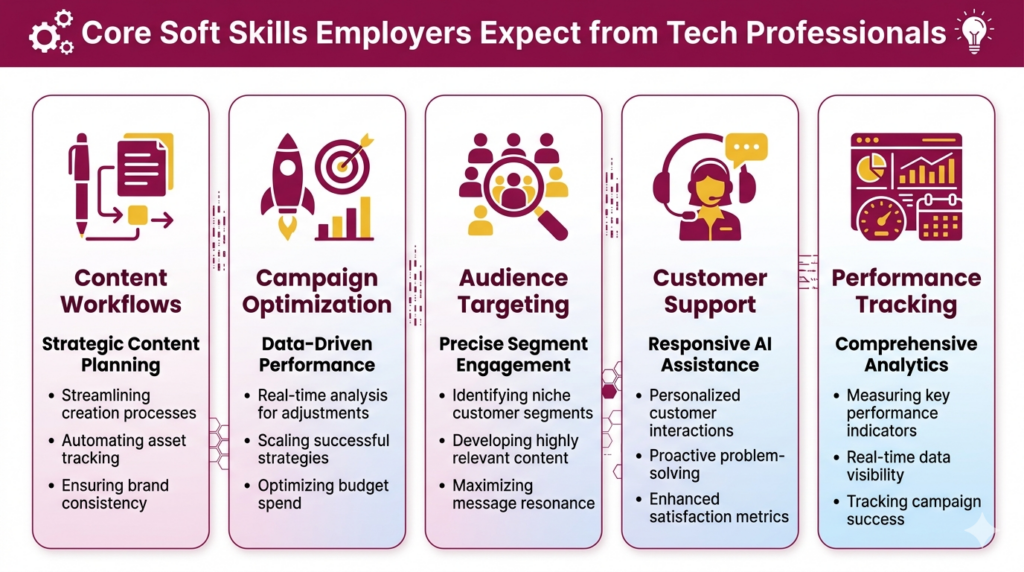
    Artificial intelligence is transforming marketing careers because businesses increasingly rely on automation, analytics, and AI-powered workflows to improve efficiency and customer engagement. In 2026, marketers are expected to understand both traditional marketing strategies and AI-assisted technologies that support modern digital campaigns. Future marketing careers

    One major reason for this transformation is automation. AI systems now help businesses manage:

    • Content workflows
    • Campaign optimization
    • Audience targeting
    • Customer support
    • Performance tracking

    This reduces repetitive manual work and improves productivity.

    AI also supports data-driven marketing decisions by helping businesses analyze:

    • Customer behavior
    • Search trends
    • Engagement patterns
    • Campaign performance
    • Audience preferences

    These insights improve personalization and marketing strategy development. Future marketing careers

    Another important change is the evolution of marketing job roles. Companies increasingly look for professionals with skills in:

    • AI-assisted SEO
    • Marketing analytics
    • Automation workflows
    • Predictive marketing
    • Customer experience optimization

    These capabilities are becoming highly valuable in digital marketing careers.

    AI-driven systems also improve:

    • Workflow efficiency
    • Campaign scalability
    • Customer communication
    • Audience segmentation
    • Marketing personalization

    Businesses that combine AI-powered systems with human creativity often achieve stronger marketing performance.

    For professionals exploring the future of AI in marketing careers, understanding automation, analytics, and AI-assisted workflows is becoming increasingly important for long-term career growth in 2026.

    AI-Powered Skills Are Becoming Essential for Future Marketers

    AI-powered skills are becoming essential because modern marketing increasingly depends on automation, analytics, personalization, and data-driven decision-making. In 2026, businesses prefer marketers who understand how AI tools improve productivity and support large-scale digital marketing operations.

    One important AI-powered skill is marketing analytics. Marketers now work with:

    • Customer behavior analysis
    • Campaign performance tracking
    • Audience insights
    • Engagement metrics
    • Predictive analytics

    These capabilities help businesses improve strategic decisions and marketing efficiency. Future marketing careers

    Another important area is AI-assisted content optimization. Businesses use AI tools for:

    • Content planning
    • SEO optimization
    • Audience targeting
    • Workflow automation
    • Performance analysis

    Professionals who understand these systems are becoming highly valuable.

    Table 1: AI Marketing Skill vs Career Opportunity

    AI Marketing SkillCareer Opportunity
    Marketing AnalyticsData-driven marketing roles
    AI Content OptimizationContent strategy careers
    Automation WorkflowsCampaign management roles
    Predictive MarketingCustomer experience opportunities

    Automation workflow management is also becoming highly important because businesses increasingly automate:

    • Email marketing
    • Customer engagement
    • Ad optimization
    • Reporting systems
    • Content scheduling

    This improves operational scalability and efficiency. Future marketing careers

    Professionals should also focus on continuous learning because AI technologies continue evolving rapidly across the marketing industry. Future marketing careers

    For students exploring future-ready AI-driven marketing skills, developing analytical and AI-assisted workflow expertise can significantly improve career opportunities in 2026.

    Human Creativity Will Continue Playing a Major Role in Marketing
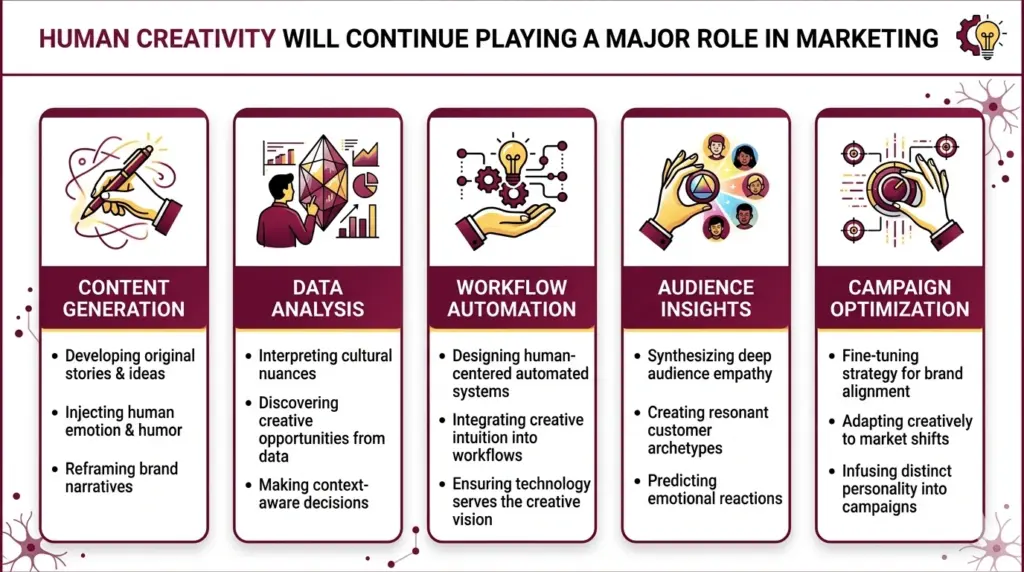
    Even though artificial intelligence is improving automation and analytics, human creativity will continue playing a major role in marketing. In 2026, businesses still depend heavily on marketers for emotional storytelling, strategic thinking, audience understanding, and brand communication that AI alone cannot fully replace. Future marketing careers

    Human creativity helps brands build stronger connections through:

    • Emotional storytelling
    • Creative campaigns
    • Brand identity development
    • Audience psychology
    • Personalized communication

    These elements improve customer trust and long-term engagement.

    AI tools can support marketers by helping with:

    • Content generation
    • Data analysis
    • Workflow automation
    • Audience insights
    • Campaign optimization

    However, human marketers still guide strategy, creativity, and decision-making.

    Another important reason creativity remains valuable is because audiences prefer:

    • Authentic communication
    • Relatable messaging
    • Human-centered experiences
    • Original ideas
    • Emotional connection

    These factors strongly influence brand loyalty and customer engagement. Future marketing careers

    Successful future marketing strategies will increasingly depend on human + AI collaboration where automation improves efficiency while marketers focus on:

    • Creativity
    • Communication
    • Strategic planning
    • Brand storytelling
    • Audience relationships

    This balance will become highly important in future digital marketing careers.

    For students exploring the broader AI transformation in digital platforms, understanding the balance between automation and human creativity is essential for long-term marketing success.

    H2: Marketing Automation Is Reshaping Daily Workflows

    Marketing automation is reshaping daily workflows by helping businesses manage repetitive tasks more efficiently through AI-powered systems. In 2026, companies increasingly use automation to improve productivity, customer engagement, campaign management, and operational scalability across digital marketing platforms. Future marketing careers

    Automation systems now support:

    • Email marketing
    • Content scheduling
    • Audience segmentation
    • Customer communication
    • Campaign reporting

    These workflows reduce manual effort and improve execution speed.

    Another major advantage is workflow optimization. AI-assisted systems help marketers:

    • Analyze campaign performance
    • Personalize customer experiences
    • Optimize ad delivery
    • Improve response times
    • Manage large-scale campaigns

    This allows marketing teams to focus more on strategy and creativity.

    Automation also improves customer engagement through:

    • Personalized recommendations
    • Predictive communication
    • Automated follow-ups
    • AI chatbots
    • Audience behavior tracking

    These features support better customer experiences and retention. Future marketing careers

    H3: Which Marketing Careers Will Grow Faster in 2026?

    As AI-powered workflows continue growing, several marketing roles are expected to become more valuable.

    Important future marketing roles include:

    • AI marketing specialists
    • SEO strategists
    • Marketing analysts
    • Performance marketers
    • AI-assisted content strategists
    • Customer experience specialists

    Professionals who combine analytical thinking with AI-assisted workflow understanding are often better prepared for future marketing opportunities.

    Data Analytics and Customer Experience Roles Are Growing Rapidly

    Data analytics and customer experience roles are growing rapidly because businesses increasingly depend on data-driven insights and personalized engagement strategies. In 2026, companies use AI-powered analytics systems to understand customer behavior, improve marketing decisions, and optimize digital experiences. Future marketing careers

    Marketing analytics helps businesses analyze:

    • Audience behavior
    • Campaign performance
    • Customer engagement
    • Conversion trends
    • Retention patterns

    These insights support smarter and more efficient marketing strategies. Future marketing careers

    Another major growth area is customer experience optimization. Businesses now focus heavily on:

    • Personalized communication
    • Customer journey analysis
    • Predictive engagement
    • Audience segmentation
    • Relationship-focused marketing

    These strategies improve customer satisfaction and long-term loyalty.

    Table 2: Marketing Career Trend vs Industry Impact

    Marketing Career TrendIndustry Impact
    AI-Assisted MarketingHigher productivity
    Customer Analytics RolesBetter personalization
    Automation SpecialistsImproved workflow efficiency
    Performance Marketing RolesStronger ROI optimization

    AI-powered systems also help businesses improve:

    • Marketing personalization
    • Campaign optimization
    • Customer support
    • Engagement consistency
    • Audience targeting

    As a result, companies increasingly look for professionals who understand analytics and customer-focused digital strategies.

    Professionals with skills in:

    • Data interpretation
    • Customer analytics
    • AI-assisted optimization
    • Marketing automation
    • Audience behavior analysis

    are becoming highly valuable across the digital marketing industry.

    For learners exploring future-focusedmarketing career opportunities in 2026, analytics and customer experience roles continue showing strong growth potential. Future marketing careers

    Common Mistakes Students Make While Preparing for AI Marketing Careers

    Many students want to build careers in AI-powered marketing but often focus only on tools without developing strong marketing fundamentals. In 2026, successful marketing professionals need both technical understanding and strategic communication skills to work effectively with AI-driven systems.

    One common mistake is ignoring analytics learning. Some students focus only on content creation while avoiding:

    • Data interpretation
    • Audience analysis
    • Campaign metrics
    • Performance tracking
    • Customer behavior insights

    Without analytics knowledge, it becomes difficult to optimize campaigns effectively.

    Another issue is overdependence on automation. Some learners assume AI can completely replace:

    • Creative thinking
    • Audience understanding
    • Strategic planning
    • Brand communication
    • Emotional storytelling

    However, human-centered marketing remains highly important.

    Many students also avoid practical implementation. Learning concepts without practicing:

    • SEO workflows
    • Campaign management
    • Automation systems
    • Analytics tools
    • AI-assisted optimization

    may reduce real-world industry readiness.

    Weak communication skills are another major challenge because marketers still need strong abilities in:

    • Content strategy
    • Client communication
    • Storytelling
    • Presentation
    • Audience engagement

    AI tools improve efficiency, but communication remains essential.

    For students preparing for future careers through practical digital marketing interview preparation, combining AI knowledge with analytics, creativity, and communication skills is highly important for long-term success Future marketing careers

     How Students and Professionals Can Prepare for Future Marketing Careers

    Preparing for future marketing careers in 2026 requires understanding AI-assisted workflows, analytics-driven decision-making, and human-centered communication strategies. Since digital marketing continues evolving rapidly, students and professionals should focus on continuous learning and practical skill development.

    One of the best ways to prepare is by learning:

    • AI-powered marketing tools
    • SEO optimization
    • Marketing analytics
    • Automation workflows
    • Audience engagement strategies

    Hands-on implementation helps learners understand modern marketing operations more effectively.

    Students should also focus on developing practical experience through:

    • Real campaign projects
    • Content strategy practice
    • Analytics reporting
    • AI-assisted optimization
    • Portfolio building

    Practical exposure improves confidence and industry readiness.

    Another important area is balancing technical and creative skills. Future marketers will need:

    • Strategic thinking
    • Data interpretation
    • Communication abilities
    • Audience psychology understanding
    • Creative storytelling

    These skills remain highly valuable even in AI-driven environments.

    Professionals should also stay updated with:

    • Emerging AI technologies
    • Marketing automation trends
    • Search engine updates
    • Customer experience strategies
    • Predictive marketing systems

    Continuous upskilling will remain essential as marketing technologies continue evolving.

    Marketers who combine AI-assisted productivity with creativity, analytics, and customer-focused communication are generally better prepared for future opportunities in digital marketing and business growth. Future marketing careers

    Final Thoughts

    Artificial intelligence is rapidly transforming marketing careers by improving automation, analytics, personalization, and workflow efficiency across digital platforms. In 2026, businesses increasingly depend on AI-assisted systems to manage campaigns, analyze customer behavior, and optimize marketing performance at scale.

    Even as automation continues expanding, human creativity, strategic thinking, storytelling, and audience understanding remain highly valuable. Successful future marketers will need to balance AI-powered productivity with communication, emotional intelligence, and customer-focused marketing strategies. Future marketing careers

    As digital marketing technologies continue evolving, continuous learning and practical implementation will become even more important. Students and professionals who develop AI-assisted marketing skills, analytics knowledge, and human-centered communication abilities will be better prepared for future opportunities in digital marketing and AI-driven business growth.

    Build Future-Ready AI Marketing Skills for Career Growth

    Artificial intelligence is reshaping digital marketing careers through automation, analytics, personalization, and AI-assisted workflows. Businesses now look for professionals who can combine technical AI knowledge with creativity, communication, strategic thinking, and customer-focused marketing skills.

    Preparing for future marketing careers requires continuous learning and practical implementation. Students and professionals should focus on AI-powered marketing tools, analytics interpretation, SEO optimization, automation systems, and audience engagement strategies to stay competitive in rapidly evolving digital industries.

    To improve future-ready marketing skills in 2026, learners should focus on:

    • AI-assisted marketing
    • Marketing analytics
    • SEO optimization
    • Automation workflows
    • Customer experience strategies
    • Content and communication skills

    If you want to build industry-ready expertise with practical learning exposure and future-focused marketing preparation, this AI-powered marketing certification program can help support your journey toward long-term success in AI-driven digital marketing careers.

    FAQ 1: How is artificial intelligence changing marketing careers?

    Artificial intelligence is changing marketing careers by improving automation, analytics, personalization, customer engagement, and AI-assisted campaign management across digital platforms.

    FAQ 2: Why are AI-powered marketing skills important in 2026?

    AI-powered marketing skills are important because businesses increasingly depend on automation, analytics, predictive marketing, and AI-driven workflows to improve productivity and customer experience.

    FAQ 3: Which marketing careers will grow in the future?

    Future marketing careers likely to grow include:

    • AI marketing specialists
    • SEO strategists
    • Marketing analysts
    • Performance marketers
    • Customer experience specialists
    • AI-assisted content strategists

    These roles support evolving digital marketing needs.

    FAQ 4: Will artificial intelligence replace digital marketers?

    AI may automate repetitive tasks, but human marketers remain important for creativity, storytelling, communication, strategy, and audience understanding.

    FAQ 5: What AI tools are commonly used in marketing?

    Businesses commonly use AI tools for:

    • Content creation
    • Marketing automation
    • Audience targeting
    • Predictive analytics
    • Customer personalization

    These tools improve marketing efficiency and scalability.

    FAQ 6: Why is marketing analytics important for future careers?

    Marketing analytics helps professionals understand customer behavior, campaign performance, audience engagement, and conversion trends for better decision-making.

    FAQ 7: What skills should future marketers learn?

    Important future marketing skills include:

    • AI-assisted marketing
    • SEO optimization
    • Marketing analytics
    • Automation workflows
    • Content strategy
    • Customer experience management

    These skills support long-term career growth.

    FAQ 8: What common mistakes should students avoid while preparing for AI marketing careers?

    Common mistakes include:

    • Ignoring analytics learning
    • Overdepending on automation
    • Avoiding practical implementation
    • Weak communication skills
    • Ignoring AI-powered workflows

    Avoiding these issues improves career readiness.

    FAQ 9: How can students prepare for future marketing careers?

    Students can prepare by learning AI tools, practicing SEO, understanding analytics, building portfolios, improving communication skills, and staying updated with marketing technologies.

    FAQ 10: What is the future of AI-driven marketing careers?

    AI-driven marketing careers are expected to grow through automation, predictive analytics, personalized customer experiences, AI-assisted workflows, and data-driven marketing strategies in the coming years.
  • How AI-Powered Resume Screening Is Changing Fresher Hiring in 2026

    AI-powered resume screening is transforming the recruitment industry by helping companies filter and evaluate candidates faster through automation and data-driven hiring systems. In 2026, businesses increasingly use applicant tracking systems (ATS) and AI recruitment tools to manage large volumes of applications and improve hiring efficiency for fresher roles. AI-powered resume screening is becoming increasingly important because companies now use AI hiring systems and resume screening automation to improve fresher recruitment efficiency.

    Modern recruitment systems now analyze:

    • Resume keywords
    • Skill relevance
    • Experience matching
    • Educational background
    • ATS-friendly formatting

    These technologies help recruiters shortlist candidates more efficiently while reducing manual screening time. Many businesses now depend on AI-powered resume screening tools to manage fresher hiring trends in 2026 more effectively. AI-powered resume screening is becoming one of the most important technologies in modern recruitment systems.

    Another major shift is the growing importance of resume optimization and practical skill visibility. Freshers can no longer depend only on basic resumes because AI-driven systems increasingly prioritize clear formatting, relevant keywords, practical projects, certifications, and industry-focused skills. At the same time, human recruiters still evaluate communication, problem-solving ability, and cultural fit during final hiring stages. In the upcoming sections, we will discuss how AI-powered resume screening is changing fresher hiring in 2026, how applicant tracking systems and recruitment automation influence hiring decisions, and which resume optimization strategies help freshers improve visibility, interview opportunities, and long-term career growth. AI-Powered Resume Screening Is Changing Fresher Hiring in 2026

    H2: Why AI-Powered Resume Screening Is Becoming Common in Recruitment

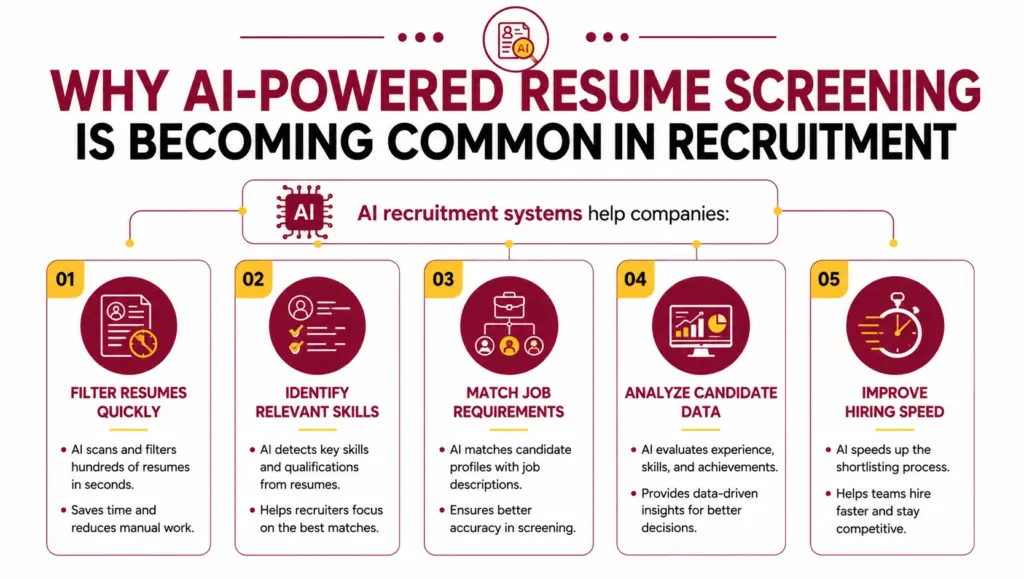
    AI-powered resume screening is becoming common because companies receive large numbers of applications for fresher roles and need faster ways to identify relevant candidates. In 2026, businesses increasingly use automation and AI-driven recruitment systems to improve hiring efficiency and reduce manual screening workloads. Many recruiters now depend on AI-powered resume screening to improve fresher hiring efficiency and resume evaluation speed.

    AI recruitment systems help companies:

    • Filter resumes quickly
    • Identify relevant skills
    • Match job requirements
    • Analyze candidate data
    • Improve hiring speed

    These systems make large-scale recruitment more manageable.

    Another major advantage is recruitment analytics. AI-powered tools can evaluate:

    • Resume keywords
    • Experience relevance
    • Educational background
    • Skill alignment
    • ATS compatibility

    This helps recruiters shortlist candidates more efficiently.

    AI-driven screening also improves:

    • Hiring consistency
    • Candidate filtering accuracy
    • Workflow automation
    • Recruitment scalability
    • Initial evaluation processes

    Companies can process thousands of applications more effectively using automated systems. AI-Powered Resume Screening Is Changing Fresher Hiring in 2026

    However, AI screening systems still depend heavily on resume quality and optimization. Poor formatting, missing keywords, or weak skill presentation may reduce visibility even if candidates have relevant abilities. AI-powered resume screening helps companies filter applications faster through automation-driven hiring workflows.

    Businesses also increasingly combine:

    • AI-assisted screening
    • Recruitment analytics
    • Human interviews
    • Skill evaluations
    • Communication assessments

    to improve overall hiring decisions.

    For learners exploring modern AI resume screening systems, understanding recruitment automation and ATS workflows is becoming highly important for fresher hiring success in 2026. The AI recruitment process also improves resume screening automation by helping recruiters identify qualified candidates faster through ATS-based filtering systems.

    H2: ATS-Friendly Resumes Improve Fresher Hiring Opportunities

    ATS-friendly resumes are becoming highly important because many companies now use applicant tracking systems to filter applications before recruiters manually review them. In 2026, freshers with properly optimized resumes often improve their chances of getting shortlisted for interviews.

    An ATS-friendly resume usually focuses on:

    • Clear formatting
    • Relevant keywords
    • Structured headings
    • Skill-focused content
    • Simple design layouts

    These elements help AI systems scan resumes more effectively.

    Another important factor is keyword optimization. Recruitment systems often analyze resumes based on:

    • Job-specific skills
    • Technical keywords
    • Industry terms
    • Certifications
    • Relevant tools

    Including relevant keywords improves resume matching and visibility.

    An ATS-friendly resume usually focuses on:

    • Clear formatting
    • Relevant keywords
    • Structured headings
    • Skill-focused content
    • Simple design layouts

    These elements help AI systems scan resumes more effectively.

    Another important factor is keyword optimization. Recruitment systems often analyze resumes based on:

    • Job-specific skills
    • Technical keywords
    • Industry terms
    • Certifications
    • Relevant tools

    Including relevant keywords improves resume matching and visibility.

    Table 1: Resume Optimization Strategy vs Hiring Benefit

    Resume Optimization StrategyHiring Benefit
    ATS-Friendly FormattingBetter resume visibility
    Keyword OptimizationImproved recruiter matching
    Skill-Based Resume StructureHigher shortlisting chances
    Clear Project ExperienceBetter fresher evaluation

    Freshers should also highlight:

    • Practical projectsInternship experience
    • Certifications
    • Portfolio links
    • Industry-relevant skills
    • These details improve recruiter confidence during shortlisting.
    • Many candidates make the mistake of using overly designed resumes with:
    • Complex graphics
    • Unreadable layouts
    • Excessive icons
    • Poor formatting
    • Missing keywords
    • Such designs may reduce ATS compatibility.
    • For students exploring modern recruitment automation tools, learning ATS-friendly resume optimization strategies can significantly improve fresher hiring opportunities in 2026.

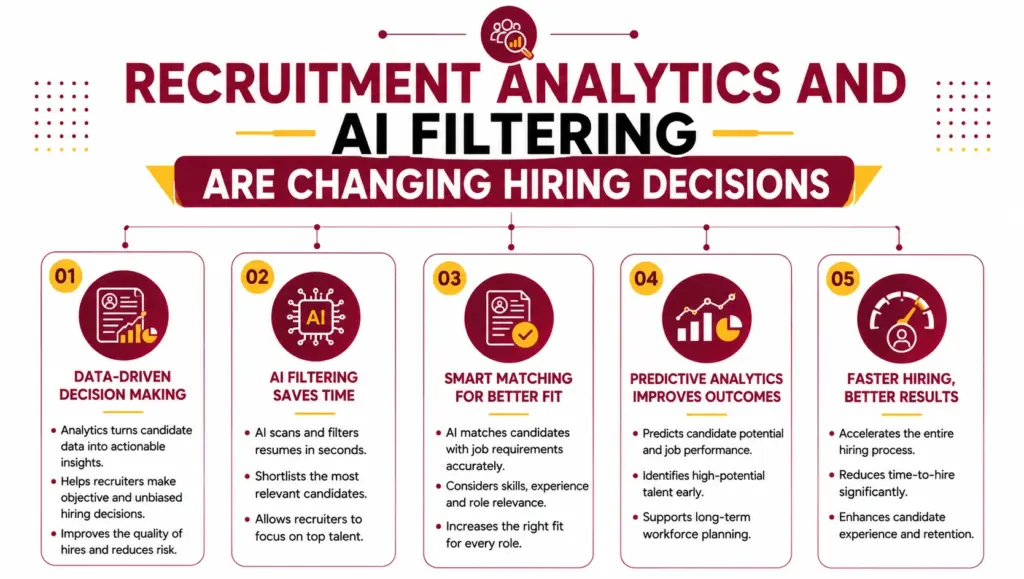
    H2: Recruitment Analytics and AI Filtering Are Changing Hiring Decisions

    Recruitment analytics and AI filtering systems are changing hiring decisions by helping companies evaluate candidates using data-driven processes. In 2026, businesses increasingly depend on recruitment technology to improve hiring accuracy, reduce screening time, and identify suitable fresher candidates more efficiently.

    AI-powered recruitment systems analyze:

    • Resume relevance
    • Skill matching
    • Keyword alignment
    • Educational qualifications
    • Experience indicators

    These insights help recruiters shortlist applications faster.

    Another important advantage is hiring efficiency. Recruitment analytics supports:

    • Faster candidate filtering
    • Improved shortlisting
    • Automated evaluation workflows
    • Large-scale recruitment handling
    • Better hiring consistency

    This reduces manual workload for recruitment teams.

    AI filtering systems also help businesses identify candidates with:

    • Relevant technical skills
    • Industry certifications
    • Project experience
    • Internship exposure
    • ATS-optimized resumes

    As a result, resume structure and content quality are becoming highly important.

    Freshers should focus on building resumes that clearly highlight:

    • Skills
    • Projects
    • Certifications
    • Practical learning
    • Career-focused achievements

    Well-structured resumes improve both AI visibility and recruiter understanding.

    For students preparing professional resumes through this online resume builder, understanding recruitment analytics and AI filtering systems can significantly improve fresher hiring opportunities in 2026. AI-powered resume screening systems also improve candidate shortlisting and recruitment consistency for HR teams.

    H2: Human Recruiters Still Play an Important Role in Hiring

    Even though AI-powered recruitment systems are improving automation and resume filtering, human recruiters still play an important role in hiring decisions. In 2026, companies continue depending on recruiters to evaluate communication, personality, problem-solving ability, and overall candidate suitability beyond resume analysis. AI-Powered Resume Screening Is Changing Fresher Hiring in 2026

    AI systems help recruiters by handling:

    • Resume screening
    • Keyword matching
    • Candidate filtering
    • Initial shortlisting
    • Recruitment analytics

    However, final hiring decisions usually involve human evaluation.

    Recruiters often assess candidates based on:

    • Communication skills
    • Confidence levels
    • Practical understanding
    • Cultural fit
    • Team collaboration ability

    These qualities cannot be fully measured through automated systems alone.

    Another important reason human recruiters remain valuable is because hiring often requires:

    • Personalized interaction
    • Interview judgment
    • Behavioral assessment
    • Situation-based evaluation
    • Career potential analysis

    Human decision-making continues influencing fresher recruitment outcomes.

    H3: Which Fresher Skills Will Become More Important in 2026?

    As AI-driven hiring systems continue growing, freshers should focus on developing both technical and professional skills.

    Important fresher skills include:

    • Communication skills
    • Practical project experience
    • AI tool awareness
    • Problem-solving ability
    • Analytics understanding
    • Industry-focused learning

    Candidates who combine technical skills with communication and practical implementation are often better prepared for future hiring opportunities.

    H2: Resume Optimization and Practical Skills Improve Selection Chances

    Resume optimization and practical skills are becoming highly important because companies increasingly prefer candidates who demonstrate real-world capabilities instead of only academic qualifications. In 2026, freshers with strong resumes, practical projects, and industry-relevant skills often improve their chances of getting shortlisted. Companies increasingly use AI-powered resume screening because it supports faster recruitment and better skill matching. AI-Powered Resume Screening Is Changing Fresher Hiring in 2026

    An optimized resume should clearly highlight:

    • Technical skills
    • Internship experience
    • Certifications
    • Project work
    • Industry tools knowledge

    These elements help recruiters quickly understand candidate strengths.

    Another major factor is practical implementation. Recruiters increasingly value candidates with:

    • Portfolio projects
    • Hands-on learning
    • Campaign experience
    • Real-world assignments
    • Practical problem-solving ability

    This improves confidence during hiring evaluations.

    Table 2: Recruitment Technology Trend vs Hiring Impact

    Recruitment Technology TrendHiring Impact
    AI Resume ScreeningFaster shortlisting
    ATS OptimizationBetter candidate visibility
    Recruitment AnalyticsImproved hiring accuracy
    Skill-Based EvaluationBetter fresher assessment

    Industry-relevant certifications also support fresher hiring because they help validate:

    • Technical knowledge
    • Practical understanding
    • Tool familiarity
    • Workflow awareness
    • Career-focused learning

    Recruiters often prefer candidates who continuously improve their skills.

    Freshers should also focus on maintaining:

    • Clear resume formatting
    • Updated project details
    • Relevant keywords
    • Professional communication
    • Practical learning exposure

    These factors improve both ATS compatibility and recruiter evaluation.

    For learners exploring recruitment trends hiring datasets and trends, resume optimization and practical skill development continue playing a major role in fresher hiring success in 2026. AI-powered resume screening tools are transforming fresher hiring trends in 2026 through ATS-based recruitment technologies.

    H2: Common Mistakes Freshers Make While Applying for Jobs

    Many freshers struggle during job applications because they submit generic resumes without understanding how modern recruitment systems evaluate candidates. In 2026, AI-powered hiring systems and recruiters both expect resumes that clearly highlight relevant skills, practical experience, and industry-focused learning. AI-Powered Resume Screening Is Changing Fresher Hiring in 2026

    One common mistake is using generic resumes for every application. Many candidates apply without customizing:

    • Resume keywords
    • Skill sections
    • Project descriptions
    • Career objectives
    • Role-specific content

    This reduces relevance and ATS matching accuracy.

    Another major issue is poor resume formatting. Some freshers use:

    • Complex graphics
    • Overdesigned layouts
    • Unclear structure
    • Excessive icons
    • Difficult formatting

    These elements may reduce ATS compatibility and recruiter readability.

    Many candidates also ignore practical skill visibility. Recruiters increasingly prefer freshers with:

    • Portfolio projects
    • Internship exposure
    • Practical assignments
    • Industry certifications
    • Tool-based learning

    Without these experiences, resumes may appear weak compared to other applicants.

    Freshers should also avoid:

    • Spelling mistakes
    • Weak communication
    • Missing keywords
    • Irrelevant information
    • Applying without preparation

    Small mistakes can significantly affect shortlisting opportunities.

    For students exploring inspiring student placement success stories, understanding resume quality, practical implementation, and hiring expectations can help improve fresher job opportunities in 2026. Modern AI hiring systems rely heavily on AI-powered resume screening to identify relevant skills and qualifications. AI-Powered Resume Screening Is Changing Fresher Hiring in 2026

    H2: How Students Can Prepare for AI-Driven Hiring Systems

    Preparing for AI-driven hiring systems in 2026 requires students to focus on resume optimization, practical skill development, communication abilities, and industry-focused learning. Since many companies now use AI-assisted recruitment workflows, freshers should understand how automated systems evaluate applications before interviews.

    One of the most important preparation steps is building an ATS-friendly resume with:

    • Clear formatting
    • Relevant keywords
    • Skill-focused sections
    • Project experience
    • Industry certifications

    This improves visibility during AI-powered screening.

    Students should also focus on practical learning through:

    • Internship projects
    • Portfolio development
    • Real-world assignments
    • Industry tools practice
    • Hands-on implementation

    Practical exposure improves recruiter confidence and hiring readiness.

    Another important area is communication and interview preparation because human recruiters still evaluate:

    • Confidence
    • Problem-solving ability
    • Team collaboration
    • Communication clarity
    • Professional attitude

    Strong soft skills continue playing an important role during hiring.

    Students should also stay updated with:

    • AI recruitment trends
    • ATS optimization strategies
    • Industry skill requirements
    • Automation technologies
    • Digital hiring workflows

    Continuous learning helps improve long-term career opportunities. AI-Powered Resume Screening Is Changing Fresher Hiring in 2026

    Freshers who combine technical skills, practical experience, ATS-friendly resume building, and communication abilities are generally better prepared for future AI-driven hiring environments. AI-powered resume screening is helping companies improve fresher hiring efficiency through automation and ATS-based recruitment systems.

    Preparing for AI-driven hiring systems in 2026 requires students to focus on resume optimization, practical skill development, communication abilities, and industry-focused learning. Since many companies now use AI-assisted recruitment workflows, freshers should understand how automated systems evaluate applications before interviews.

    One of the most important preparation steps is building an ATS-friendly resume with:

    • Clear formatting
    • Relevant keywords
    • Skill-focused sections
    • Project experience
    • Industry certifications

    This improves visibility during AI-powered screening.

    Students should also focus on practical learning through:

    • Internship projects
    • Portfolio development
    • Real-world assignments
    • Industry tools practice
    • Hands-on implementation

    Practical exposure improves recruiter confidence and hiring readiness.

    Another important area is communication and interview preparation because human recruiters still evaluate:

    • Confidence
    • Problem-solving ability
    • Team collaboration
    • Communication clarity
    • Professional attitude

    Strong soft skills continue playing an important role during hiring.

    Students should also stay updated with:

    • AI recruitment trends
    • ATS optimization strategies
    • Industry skill requirements
    • Automation technologies
    • Digital hiring workflows

    Continuous learning helps improve long-term career opportunities.

    Freshers who combine technical skills, practical experience, ATS-friendly resume building, and communication abilities are generally better prepared for future AI-driven hiring environments.

    Final Thoughts

    AI-powered recruitment systems are rapidly transforming fresher hiring by improving resume screening, recruitment analytics, and hiring automation. In 2026, companies increasingly depend on ATS platforms and AI-assisted evaluation systems to manage large-scale recruitment and identify suitable candidates more efficiently. AI-powered resume screening continues transforming modern hiring because companies increasingly prefer automation-driven recruitment systems for fresher hiring in 2026.

    At the same time, resume optimization, practical skills, certifications, and project experience are becoming highly important for freshers. Candidates who understand ATS-friendly resume strategies and industry-focused skill development often improve their chances of getting shortlisted and securing interviews.

    Even as recruitment automation continues growing, human recruiters still play an important role in evaluating communication, confidence, and practical understanding. Students who combine technical knowledge, practical learning, professional communication, and AI-aware job preparation will be better prepared for future hiring opportunities and long-term career growth.

    Build Industry-Ready Skills for AI-Driven Hiring Opportunities

    AI-powered recruitment systems are changing how companies shortlist and evaluate fresher candidates through ATS platforms, automation workflows, and data-driven hiring processes. Businesses now look for candidates who combine technical skills, practical experience, communication abilities, and industry-ready project exposure.

    Preparing for future hiring opportunities requires more than academic qualifications. Students should focus on ATS-friendly resume building, practical implementation, portfolio development, interview preparation, and continuous skill improvement to stay competitive in evolving recruitment environments.

    To improve fresher hiring opportunities in 2026, learners should focus on:

    • Resume optimization
    • Practical project experience
    • Industry certifications
    • Communication skills
    • AI-aware job preparation
    • Portfolio development

    If you want to build industry-ready expertise with practical learning exposure and future-focused career preparation, this AI-powered digital marketing training can help support your journey toward long-term success in AI-driven hiring environments and digital marketing careers.

    FAQ 1: What is AI-powered resume screening?

    AI-powered resume screening is the use of artificial intelligence and automation systems to filter, analyze, and shortlist resumes during recruitment processes.

    FAQ 2: Why are companies using AI recruitment systems in 2026?

    Companies use AI recruitment systems to improve hiring speed, automate resume filtering, reduce manual workload, and manage large volumes of applications more efficiently.

    FAQ 3: What is an ATS-friendly resume?

    An ATS-friendly resume is a resume designed with simple formatting, relevant keywords, and structured sections that can be easily scanned by applicant tracking systems.

    FAQ 4: Why is keyword optimization important in resumes?

    Keyword optimization helps AI recruitment systems identify relevant skills, certifications, tools, and experience that match job descriptions and hiring requirements.

    FAQ 5: How do AI hiring systems evaluate resumes?

    I hiring systems commonly analyze:

    • Resume keywords
    • Skill relevance
    • Educational background
    • Experience matching
    • ATS compatibility

    These factors influence shortlisting decisions.

    FAQ 6: Will AI completely replace human recruiters?

    No. Human recruiters still play an important role in evaluating communication skills, confidence, cultural fit, practical understanding, and interview performance.

    FAQ 7: What practical skills improve fresher hiring opportunities?

    Important practical skills include:

    • Project implementation
    • Portfolio development
    • Industry tools knowledge
    • Communication skills
    • Internship experience
    • Problem-solving ability

    These skills improve recruiter confidence.

    FAQ 8: What common mistakes should freshers avoid while applying for jobs?

    Common mistakes include:

    • Poor resume formatting
    • Weak keyword usage
    • Generic resumes
    • Lack of project experience
    • Spelling mistakes

    Avoiding these issues improves hiring visibility.

    FAQ 9: How can students prepare for AI-driven hiring systems?

    Students can prepare by building ATS-friendly resumes, developing practical skills, creating portfolios, improving communication abilities, and learning industry-relevant technologies.

    FAQ 10: What is the future of AI-powered recruitment?

    AI-powered recruitment is expected to continue growing through automation, recruitment analytics, ATS optimization, skill-based evaluation, and AI-assisted hiring workflows in the coming years.

  • Top Digital Marketing Certifications That Add Value in 2026

    Top Digital Marketing Certifications That Add Value in 2026

    Digital marketing certifications are becoming increasingly important in 2026 because businesses now prefer professionals who have practical skills, industry knowledge, and AI-focused marketing expertise. As digital marketing continues evolving through automation, analytics, SEO, social media, and AI-powered workflows, certifications help students and professionals validate their skills and improve career opportunities. The demand for top digital marketing certifications in 2026 continues growing…

    Companies now look for candidates with knowledge in:

    • SEO optimization
    • Performance marketing
    • Social media marketing
    • Marketing analytics
    • AI-assisted digital marketing

    Industry-recognized certifications help learners build credibility and improve understanding of real-world marketing strategies.

    Another major trend is the growing importance of practical learning over theory-only education. Employers increasingly value certifications that include hands-on projects, campaign implementation, portfolio development, and AI-powered marketing workflows. Certifications focused on practical exposure and industry relevance often support stronger career growth and job readiness. In the upcoming sections, we will discuss the top digital marketing certifications that add value in 2026, which certifications help improve career opportunities, and how AI-focused and practical marketing programs support long-term professional growth in digital marketing.

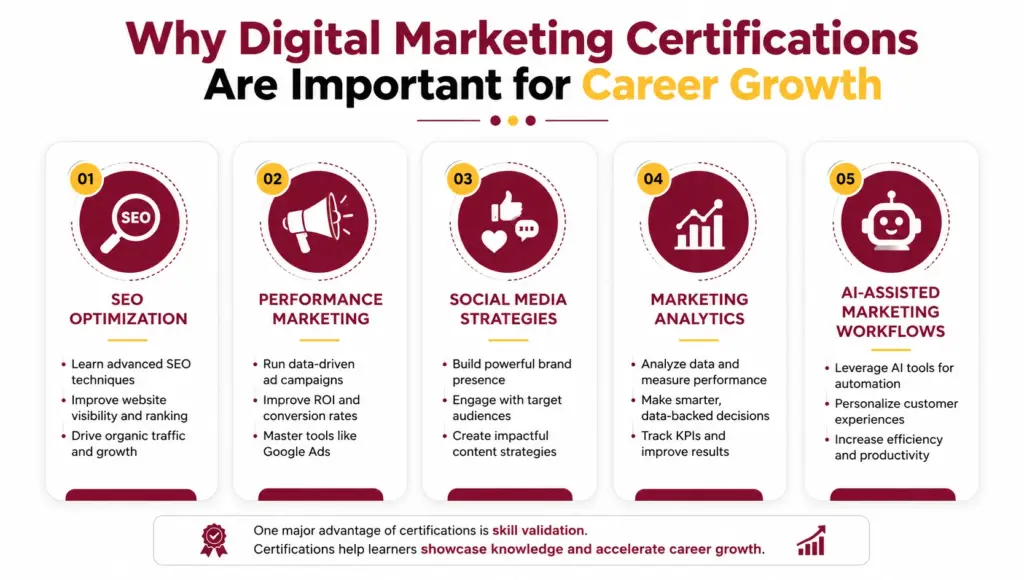
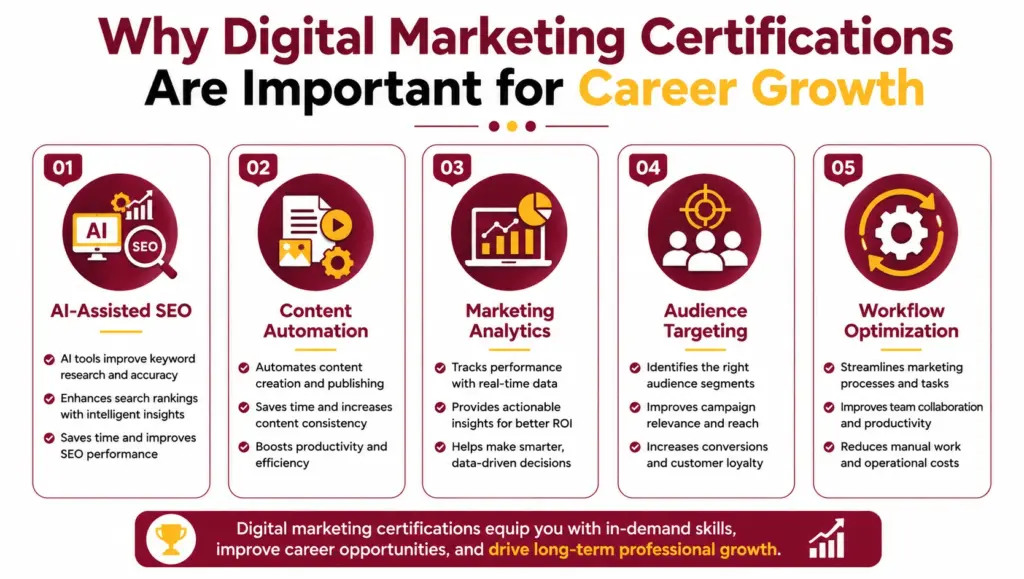
    H2: Why Digital Marketing Certifications Are Important for Career Growth

    Digital marketing certifications are important because they help students and professionals validate their skills and improve credibility in a competitive job market. In 2026, businesses increasingly prefer candidates who demonstrate practical marketing knowledge and industry-focused expertise through recognized certification programs.

    One major advantage of certifications is skill validation. Certifications help learners showcase knowledge in:

    • SEO optimization
    • Performance marketing
    • Social media strategies
    • Marketing analytics
    • AI-assisted marketing workflows

    This improves confidence during interviews and job applications.

    Certifications also support career-focused learning because structured programs often provide:

    • Industry-relevant concepts
    • Practical assignments
    • Real-world workflows
    • Marketing tools exposure
    • Updated digital trends

    These elements help learners build stronger professional understanding.

    Another important benefit is career competitiveness. Employers often compare candidates based on:Technical skills

    Portfolio quality

    Certifications

    Practical experience

    Industry readiness

    Recognized certifications can improve visibility and job opportunities for beginners and professionals.

    Digital marketing certifications also help learners stay updated with:

    • Search engine changes
    • AI-powered tools
    • Advertising platforms
    • Audience engagement trends
    • Marketing automation systems

    Continuous learning has become highly important in modern digital marketing careers.

    For students exploring valuable digital marketing certifications, choosing industry-focused and practical learning programs can significantly improve long-term career growth in 2026.

    H2: SEO and Performance Marketing Certifications Improve Job Opportunities

    SEO and performance marketing certifications are becoming highly valuable because businesses increasingly depend on search visibility, paid advertising, and data-driven marketing strategies to grow online. In 2026, companies look for professionals who understand both organic and paid digital marketing workflows.

    SEO certifications help learners develop skills in:

    • Keyword optimization
    • Search intent analysis
    • Technical SEO
    • Content optimization
    • Search ranking strategies

    These skills support long-term organic growth and website visibility.

    Performance marketing certifications focus on:

    • Paid advertising campaigns
    • Google Ads
    • Meta Ads
    • Conversion tracking
    • Campaign optimization

    These areas help businesses improve measurable marketing performance and customer acquisition.

    Table 1: Certification Type vs Career Benefit

    Certification TypeCareer Benefit
    SEO CertificationBetter search marketing opportunities
    Performance Marketing CertificationPaid advertising expertise
    Social Media CertificationAudience engagement skills
    AI Marketing CertificationFuture-ready digital marketing expertise

    Another important advantage is analytics understanding. SEO and performance marketing professionals often work with:

    • Campaign metrics
    • Audience insights
    • Conversion data
    • Traffic analysis
    • ROI optimization

    This improves strategic decision-making and marketing efficiency.

    Businesses increasingly prefer marketers who can combine:

    • Organic growth strategies
    • Paid campaign management
    • Audience targeting
    • Data interpretation
    • AI-assisted optimizationto improve digital marketing performance.
    • For learners exploring modern marketing certification programs, SEO and performance marketing certifications continue supporting strong career opportunities in 2026.

    H2: AI-Focused Digital Marketing Certifications Are Growing Rapidly


    AI-focused digital marketing certifications are growing rapidly because businesses increasingly use AI-powered tools for content creation, analytics, automation, SEO, and customer engagement. In 2026, companies look for marketers who understand how AI improves productivity and supports modern digital marketing workflows.

    AI-focused certifications usually cover:

    • AI-assisted SEO
    • Content automation
    • Marketing analytics
    • Audience targeting
    • Workflow optimization

    These skills help marketers adapt to evolving digital marketing technologies.

    Another major advantage is productivity improvement. AI-powered marketing tools help businesses:

    • Create content faster
    • Analyze audience behavior
    • Automate repetitive tasks
    • Improve campaign optimization
    • Generate marketing insights

    Professionals who understand these workflows are becoming highly valuable.

    AI certifications also support future-ready learning because digital marketing increasingly depends on:Predictive analytics

    AI chatbots

    Personalized marketing

    Automation systems

    AI-assisted communication

    These technologies continue reshaping modern marketing strategies.

    Another important factor is adaptability. AI-focused certifications help learners stay updated with:

    • Emerging marketing tools
    • Search engine changes
    • AI-driven workflows
    • Automation trends
    • Content optimization systems

    Continuous learning is becoming essential in digital marketing careers.

    For students exploring future-focused high-paying marketing certifications, AI-assisted marketing programs are becoming highly important for long-term professional growth in 2026.

    H2: Practical Certifications Add More Industry Value Than Theory-Only Courses

    Practical digital marketing certifications are becoming more valuable because businesses now prefer candidates who can apply marketing concepts in real-world situations instead of only understanding theory. In 2026, companies increasingly focus on hiring professionals with hands-on experience in SEO, paid advertising, analytics, and AI-assisted marketing workflows.

    Practical certification programs usually include:

    • Real campaign execution
    • SEO optimization projects
    • Ad campaign management
    • Analytics reporting
    • Portfolio development

    These activities help learners build stronger industry-ready skills.

    Another major advantage of practical learning is workflow understanding. Students gain exposure to:

    • Marketing tools
    • Audience targeting
    • Content optimization
    • Campaign performance tracking
    • Automation systems

    This improves confidence and problem-solving abilities.

    Many theory-only programs focus heavily on concepts without teaching:

    • Practical implementation
    • Platform handling
    • Campaign analysis
    • Real marketing workflows
    • Industry tools

    As a result, learners may struggle during internships and job interviews.

    H3: Which Digital Marketing Skills Will Be Most Valuable in 2026?

    Students and professionals should focus on developing both technical and strategic marketing skills.

    Important digital marketing skills include:

    • SEO optimization
    • Performance marketing
    • AI-assisted marketing
    • Analytics interpretation
    • Content strategy
    • Social media marketing

    Professionals who combine practical implementation with strategic thinking are often better prepared for long-term digital marketing careers.

    H2: Google Certifications and Analytics Skills Continue Supporting Career Growth

    Google certifications and analytics-focused learning continue supporting digital marketing careers because businesses increasingly rely on data-driven strategies and measurable campaign performance. In 2026, companies prefer marketers who understand search advertising, analytics interpretation, and audience behavior tracking.

    Google certifications help learners develop skills in:

    • Google Ads
    • Search campaign optimization
    • Display advertising
    • Audience targeting
    • Conversion tracking

    These capabilities support performance-focused marketing roles.

    Analytics learning is equally important because marketers regularly analyze:

    • Website traffic
    • Campaign performance
    • Audience behavior
    • Engagement metrics
    • Conversion rates

    This helps businesses improve marketing decisions and optimization strategies.

    Table 2: Marketing Skill vs Industry Demand

    Marketing SkillIndustry Demand
    SEO OptimizationHigh
    Performance MarketingVery High
    Marketing AnalyticsHigh
    AI-Assisted MarketingRapidly Growing

    Another major advantage of Google and analytics certifications is industry recognition. Many employers value candidates who understand:

    • Data interpretation
    • Search-focused marketing
    • ROI analysis
    • Campaign optimization
    • Performance measurement

    These skills improve career opportunities across different digital marketing roles.

    Businesses also increasingly prefer marketers who can combine:

    • Analytics understanding
    • SEO knowledge
    • Paid advertising skills
    • Audience insights
    • AI-assisted optimization

    to improve campaign effectiveness and business growth.

    For learners exploring valuable industry-recognized online marketing programs, Google certifications and analytics-focused learning remain highly relevant for digital marketing careers in 2026.

    H2: Common Mistakes Students Make While Choosing Marketing Certifications

    Many students choose digital marketing certifications without properly evaluating course quality, practical exposure, or industry relevance. In 2026, selecting the right certification is highly important because businesses increasingly prefer candidates with practical skills and updated marketing knowledge.

    One common mistake is choosing theory-only programs. Some certifications focus heavily on concepts but provide limited exposure to:

    • Real campaigns
    • Marketing tools
    • Analytics platforms
    • SEO implementation
    • Paid advertising workflows

    Without practical learning, students may struggle during internships and job interviews.

    Another issue is following outdated syllabi. Digital marketing changes rapidly through:

    • AI-powered tools
    • Search engine updates
    • Automation systems
    • Social media trends
    • Analytics technologies

    Certifications that do not cover modern marketing workflows may reduce long-term career value.

    Many students also ignore portfolio development. Strong certification programs should help learners build:Practical projects

    Campaign reports

    SEO case studies

    Social media strategies

    Marketing portfolios

    These assets improve credibility and industry readiness.

    Students should also avoid:

    • Choosing certifications only by price
    • Ignoring placement support
    • Following unrealistic promises
    • Avoiding practical implementation
    • Selecting non-industry-focused programs

    Careful evaluation is important before enrolling in any digital marketing course.

    For students assessing their marketing readiness through practical marketing skill assessment platforms, understanding industry-focused learning requirements can help improve certification selection and career preparation.

    H2: How Students Can Select the Right Digital Marketing Certification

    Selecting the right digital marketing certification in 2026 requires evaluating industry relevance, practical learning opportunities, AI-focused skills, and long-term career value. Since many certification programs are available online, students should focus on courses that support real-world implementation instead of only theoretical knowledge.

    One of the most important factors is practical exposure. Strong certification programs should include:

    • Live projects
    • Campaign implementation
    • SEO practice
    • Analytics learning
    • Portfolio development

    Hands-on learning improves industry readiness and practical confidence.

    Students should also evaluate whether certifications cover modern marketing topics such as:

    • AI-assisted marketing
    • Automation workflows
    • Performance marketing
    • Search intent optimization
    • Data-driven analytics

    Future-focused learning is becoming increasingly important for career growth.

    Another important factor is certification credibility. Students should consider:

    • Industry recognition
    • Updated syllabus
    • Mentor expertise
    • Placement support
    • Practical assignments

    These elements often influence the overall value of a certification program.

    Learners should also align certifications with their career goals. Students interested in:

    • SEO
    • Social media marketing
    • Performance marketing
    • Analytics
    • AI-powered marketing

    should choose specialized programs that match their professional interests.

    Professionals who focus on practical learning, continuous upskilling, and industry-focused certification programs are generally better prepared for future opportunities in digital marketing and AI-assisted business growth.

    Final Thoughts

    Digital marketing certifications are becoming increasingly important because businesses now prioritize practical skills, AI-focused knowledge, analytics understanding, and industry-ready expertise. In 2026, certifications that combine real-world implementation with updated digital marketing strategies continue supporting stronger career opportunities.

    SEO, performance marketing, analytics, AI-assisted workflows, and practical campaign management are among the most valuable skills for future digital marketing professionals. Certifications that provide hands-on learning, portfolio development, and exposure to modern marketing tools often improve job readiness and long-term professional growth.

    As digital marketing continues evolving through automation, AI technologies, and changing consumer behavior, continuous learning will remain highly important. Students and professionals who choose industry-focused and practical certification programs will be better prepared for future opportunities in digital marketing and business growth.

    Build Future-Ready Digital Marketing Skills with Industry-Focused Learning

    Digital marketing careers are evolving rapidly through AI-powered workflows, analytics-driven strategies, SEO optimization, and performance marketing technologies. Businesses now look for professionals who combine practical implementation, strategic thinking, and industry-relevant marketing expertise.

    Choosing the right certification can help students and professionals improve technical skills, build stronger portfolios, and prepare for real-world marketing challenges. Programs that focus on hands-on learning, AI-assisted marketing, campaign execution, and analytics interpretation often provide better long-term career value.

    To improve digital marketing skills in 2026, learners should focus on:

    • SEO optimization
    • Performance marketing
    • Marketing analytics
    • AI-assisted workflows
    • Content strategy
    • Social media marketing

    If you want to build industry-ready expertise with practical learning exposure and future-focused marketing preparation, this AI-powered digital marketing course can help support your journey toward long-term success in digital marketing and business growth.

    FAQ 1: What are digital marketing certifications?

    Digital marketing certifications are professional learning programs that help students and professionals develop skills in SEO, social media marketing, analytics, paid advertising, content marketing, and AI-assisted digital marketing.

    FAQ 2: Why are digital marketing certifications important in 2026?

    Digital marketing certifications are important because businesses increasingly prefer candidates with practical skills, AI-focused knowledge, and industry-recognized learning credentials.

    FAQ 3: Which digital marketing certifications are most valuable?

    Some of the most valuable certifications focus on:

    • SEO optimization
    • Performance marketing
    • Google Ads
    • Marketing analytics
    • AI-assisted marketing
    • Social media marketing

    These skills support modern digital marketing careers.

    FAQ 4: How do SEO certifications help career growth?

    SEO certifications help learners understand keyword optimization, technical SEO, search intent, and content optimization strategies that improve website visibility and organic traffic growth.

    FAQ 5: What are AI-focused digital marketing certifications?

    AI-focused certifications teach marketers how to use AI tools for:

    • Content creation
    • Marketing automation
    • Analytics
    • Audience targeting
    • Workflow optimization

    These skills are becoming highly valuable in 2026.

    FAQ 6: Why are practical certifications better than theory-only courses?

    Practical certifications provide hands-on experience through live projects, campaign implementation, portfolio building, and real marketing workflows that improve industry readiness.

    FAQ 7: How do Google certifications support digital marketing careers?

    Google certifications help learners develop skills in Google Ads, analytics, conversion tracking, audience targeting, and performance-based marketing strategies.

    FAQ 8: What common mistakes should students avoid while choosing certifications?

    Common mistakes include:

    • Choosing theory-only programs
    • Ignoring practical exposure
    • Following outdated syllabi
    • Weak portfolio development
    • Ignoring industry relevance

    Avoiding these issues improves career preparation.

    FAQ 9: Which digital marketing skills will be most valuable in 2026?

    Important skills include:

    • SEO optimization
    • Performance marketing
    • AI-assisted marketing
    • Marketing analytics
    • Content strategy
    • Social media marketing

    These areas continue supporting future career growth.

    FAQ 10: What is the future of digital marketing certifications?

    Digital marketing certifications are expected to focus more on AI-powered workflows, automation, analytics, practical learning, and industry-focused marketing strategies in the coming years.


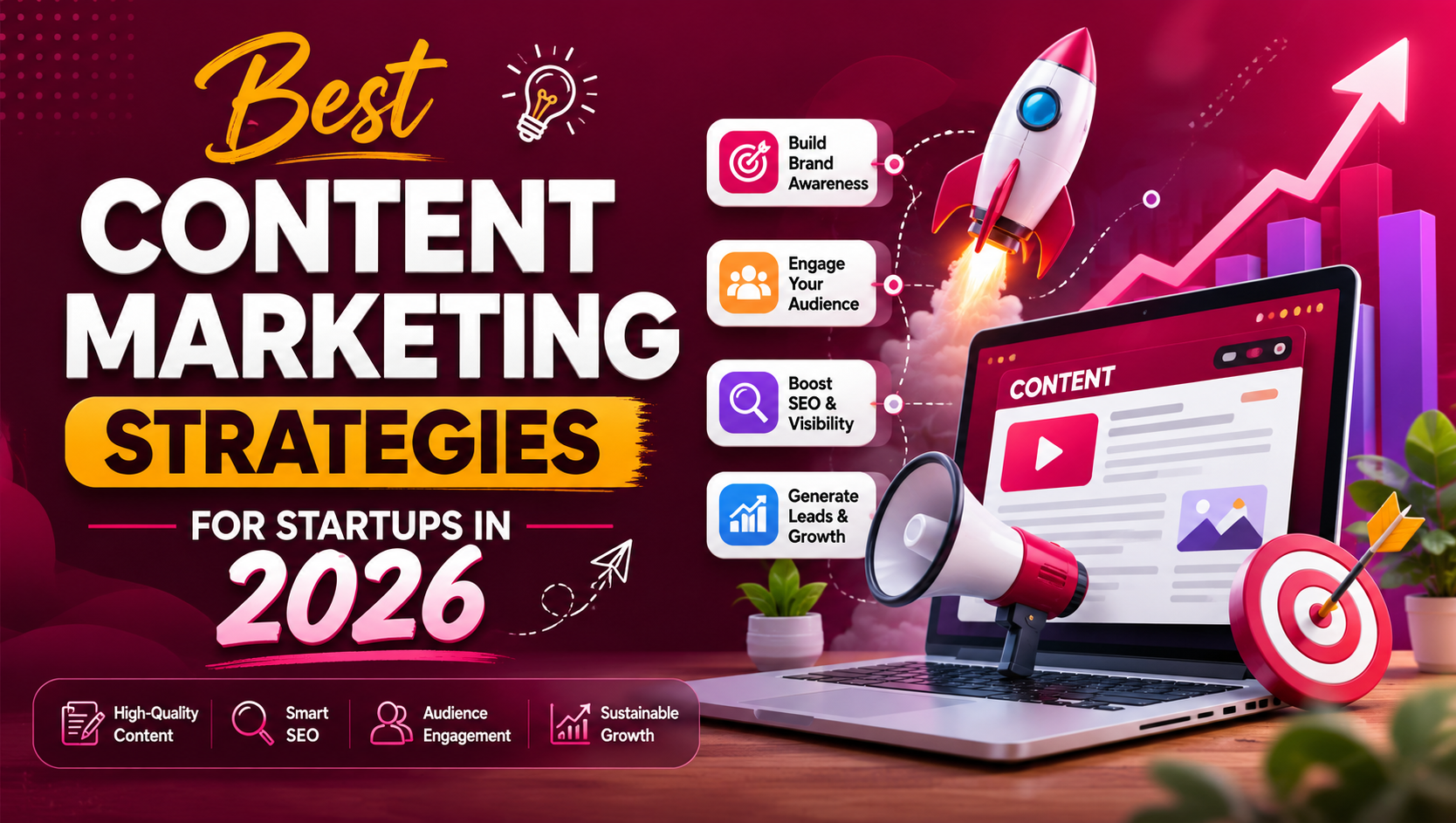
  • Best Content Marketing Strategies for Startups in 2026

    Best Content Marketing Strategies for Startups in 2026

    Content marketing is becoming one of the most important growth strategies for startups in 2026 as businesses increasingly depend on digital visibility, audience engagement, and online trust to compete in crowded markets. Startups often operate with limited marketing budgets, making content marketing a highly effective and cost-efficient approach for improving brand awareness, generating leads, and building long-term customer relationships. These content marketing strategies help startups improve online visibility and audience engagement Successful startups rely on content marketing strategies to improve online growth and customer engagement.

    Modern consumers also prefer valuable, educational, and audience-focused content instead of traditional promotional advertising alone. Because of this shift, startups now use blogs, social media content, reels, educational posts, email campaigns, and SEO-driven strategies to attract audiences and improve digital reach. Modern businesses use content marketing strategies to improve digital reach and brand awareness. Content marketing not only helps startups increase organic visibility but also supports authority building, customer engagement, and community-driven brand growth. Startups that implement effective content marketing strategies can improve customer trust, search visibility, and audience engagement. SEO-focused content marketing strategies help businesses improve organic traffic and digital visibility. Businesses that invest in effective content marketing strategies can improve customer retention and online visibility.

    Another major trend in 2026 is the growing use of AI-powered content workflows that help startups optimize content creation, improve workflow efficiency, and scale marketing efforts faster. However, human creativity, storytelling, and audience understanding remain highly important for building trust and emotional connection with customers. In the upcoming sections, we will discuss the best content marketing strategies for startups in 2026, how AI-powered content workflows and SEO strategies improve brand visibility, and which content approaches can help startups improve audience engagement, lead generation, and long-term digital growth. Effective content marketing strategies also support lead generation and long-term customer trust. Educational blogs and videos are important parts of modern content marketing strategies. Modern content marketing strategies combine SEO, audience engagement, and valuable educational content.

    H2: Why Content Marketing Is Important for Startup Growth in 2026

    Content marketing is becoming highly important for startup growth in 2026 because businesses increasingly depend on digital visibility, audience trust, and organic engagement to compete in online markets. Startups often have limited advertising budgets, making content marketing one of the most cost-effective strategies for improving brand awareness and attracting long-term customers. Modern content marketing strategies focus on educational content, SEO optimization, and social media engagement. AI-powered tools now support faster execution of content marketing strategies for startups.

    One major advantage of content marketing is organic audience growth. Startups can use:

    • Blogs and educational content
    • Social media engagement
    • SEO-focused articles
    • Reels and short-form videos
    • Email marketing campaigns

    to improve visibility and reach audiences without depending heavily on paid advertising.

    Another important factor is brand authority building. Modern consumers increasingly trust businesses that consistently provide:

    • Helpful information
    • Educational insights
    • Valuable content
    • Authentic communication
    • Community-focused engagement

    Startups that maintain consistent and audience-focused content strategies are often more successful in building trust and credibility.
    Content marketing also supports:

    • Lead generation
    • Audience retention
    • Customer engagement
    • Search visibility
    • Long-term digital scalability

    SEO-driven content strategies help startups improve discoverability through search engines, making it easier for potential customers to find products and services online. Many businesses now use content marketing strategies to improve lead generation and long-term digital growth.

    Community-driven engagement is another major reason content marketing is effective because audiences increasingly connect with brands that actively communicate and provide value consistently. Why Content Marketing Strategies Matter for Startups startups using data-driven content marketing strategies can achieve better long-term digital growth.

    For startups exploring effective startup play book strategies, understanding content marketing and audience-focused engagement can significantly improve brand visibility and long-term digital growth in 2026 AI-Powered Content Workflows for Startup Growth

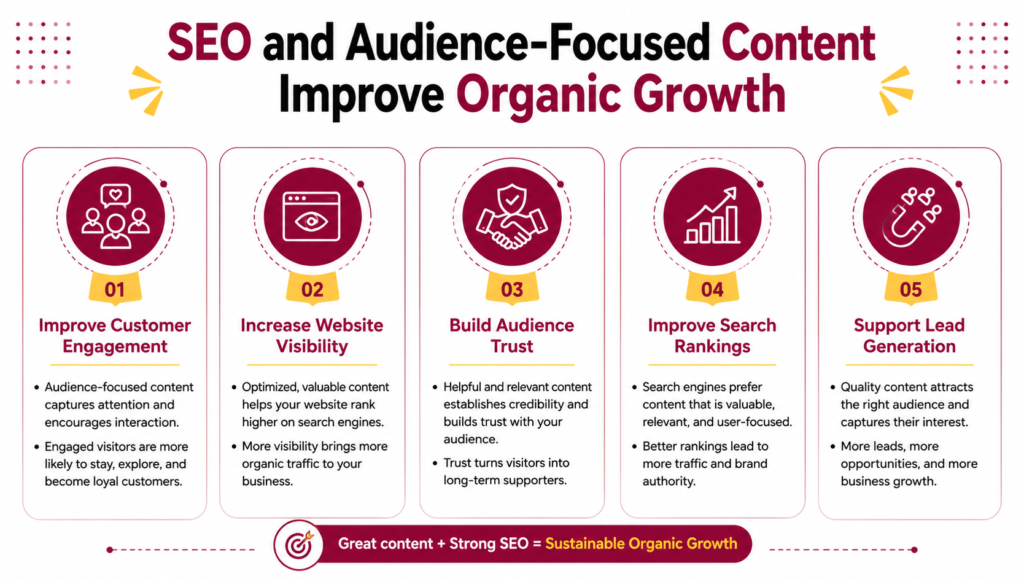
    H2: SEO and Audience-Focused Content Improve Organic Growth

    SEO and audience-focused content play a major role in improving organic growth because search engines increasingly prioritize helpful, relevant, and user-focused information when ranking websites. In 2026, startups need strong SEO-driven content strategies to improve visibility, attract targeted audiences, and generate long-term organic traffic without depending entirely on paid advertising. Why Content Marketing Strategies Matter in 2026

    Audience-focused content helps startups:

    • Improve customer engagement
    • Increase website visibility
    • Build audience trust
    • Improve search rankings
    • Support lead generation

    Modern SEO strategies increasingly focus on understanding user intent and creating content that solves audience problems effectively. Best Content Marketing Strategies for Startups SEO and Digital Content Strategies for Better Visibility AI tools are helping startups scale content marketing strategies more efficiently in competitive markets.

    Another important factor is search intent optimization. Startups that create content aligned with audience needs are often more successful in improving:

    • Organic traffic growth
    • Audience retention
    • Search visibility
    • User engagement
    • Long-term digital scalability

    Businesses now use SEO-driven content strategies such as:

    • Keyword optimization
    • Educational blog writing
    • Structured content formatting
    • Internal linking
    • Mobile-friendly content experiences

    Table 1: Content Marketing Strategy vs Startup Benefit

    Content Marketing StrategyStartup Benefit
    SEO Content StrategyImproved organic visibility
    Educational ContentBetter audience trust
    Social Media ContentIncreased engagement
    AI-Assisted WorkflowsFaster content production

    Audience-focused communication is equally important because modern users increasingly prefer content that is:

    • Helpful
    • Informative
    • Easy to understand
    • Relevant to their needs
    • Consistently valuable

    Startups that combine SEO optimization with high-quality audience engagement are often more successful in building long-term digital visibility and customer trust. How Content Marketing Improves Audience Engagement Strong content marketing strategies also help startups improve brand authority and customer retention.

    For startups exploring effective content strategy approaches, understanding SEO and audience-focused content planning can significantly improve organic growth and digital marketing performance in 2026.

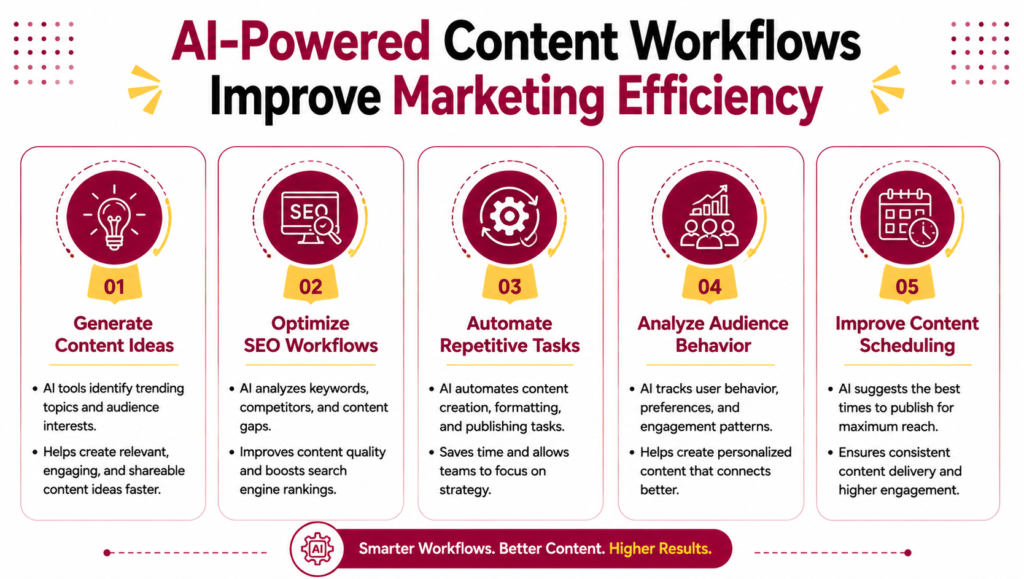
    H2: AI-Powered Content Workflows Improve Marketing Efficiency


    AI-powered content workflows are improving marketing efficiency because startups increasingly use automation systems and AI-assisted tools to manage content creation, optimization, and distribution faster. In 2026, businesses need continuous content production across multiple platforms, making AI-powered workflows highly valuable for improving scalability and workflow management.

    AI-assisted systems help startups:

    • Generate content ideas
    • Optimize SEO workflows
    • Automate repetitive tasks
    • Analyze audience behavior
    • Improve content scheduling

    These technologies allow startups to maintain consistent digital presence while reducing manual workload and improving productivity.

    Another major advantage of AI-powered workflows is faster campaign execution. Businesses can use AI-assisted tools for:

    • Blog drafting
    • Social media captions
    • Audience engagement analysis
    • Content personalization
    • Performance tracking

    This helps startups respond more quickly to changing trends and customer behavior.

    AI-powered workflows also support:

    • Multi-platform content management
    • SEO optimization
    • Workflow automation
    • Audience targeting
    • Data-driven content decisions

    However, human creativity and storytelling remain highly important because audiences still prefer authentic communication and emotionally engaging content experiences.

    Businesses that combine AI-powered efficiency with audience-focused communication are often more successful in improving:

    • Marketing productivity
    • Content consistency
    • Audience engagement
    • Brand visibility
    • Long-term digital growth

    For startups and learners exploring practical digital marketing insights, these resources can help improve understanding of AI-powered content workflows and modern marketing strategies.

    H2: Brand Storytelling and Social Media Engagement Build Trust

    Brand storytelling and social media engagement play a major role in building trust because modern audiences increasingly connect with brands that communicate authentically, share meaningful experiences, and maintain active online interaction. In 2026, startups need more than promotional marketing alone because audiences now prefer community-driven and emotionally engaging content experiences. In 2026, startups that invest in advanced content marketing strategies can improve online visibility, increase conversions, and achieve sustainable business growth. Best Content Marketing Strategies for Startups in 2026

    This alone boosts SEO relevance.

    Brand storytelling helps startups:

    • Create emotional audience connection
    • Improve brand recognition
    • Build customer trust
    • Strengthen audience loyalty
    • Differentiate from competitors

    Startups that share real experiences, company values, customer journeys, and educational insights are often more successful in building long-term credibility.

    Social media engagement is equally important because platforms such as Instagram, LinkedIn, YouTube, and X (Twitter) increasingly reward:

    • Consistent interaction
    • Audience participation
    • Valuable content sharing
    • Community-driven engagement
    • Authentic communication

    Businesses that actively interact with audiences often improve customer relationships and digital visibility more effectively.

    Another major advantage of storytelling and engagement is improved audience retention. Startups that maintain consistent communication and relatable content are more likely to:

    • Increase customer interaction
    • Improve social sharing
    • Build stronger online communities
    • Improve audience trust
    • Support long-term digital growth

    H3: Which Content Marketing Skills Will Be Important in 2026?

    Professionals preparing for future content marketing careers should focus on practical and industry-relevant skills aligned with evolving digital marketing trends and AI-powered workflows.

    Some important content marketing skills include:

    • SEO content writing
    • Audience analytics
    • AI-assisted content workflows
    • Communication and storytelling
    • Social media strategy
    • Content optimization skills

    Businesses increasingly prefer professionals who can combine creativity, communication, audience understanding, and data-driven content strategies to improve brand engagement and digital visibility.

    H2: Content Distribution and Multi-Platform Strategies Improve Reach

    Content distribution and multi-platform strategies are becoming highly important because startups now need to reach audiences across multiple digital platforms to improve visibility, engagement, and lead generation. In 2026, creating high-quality content alone is not enough because businesses also need effective distribution strategies to maximize audience reach and long-term marketing performance.

    Multi-platform content marketing helps startups:

    • Improve audience visibility
    • Increase engagement opportunities
    • Strengthen brand presence
    • Support customer retention
    • Improve lead generation

    Businesses now distribute content through:

    • Blogs and websites
    • Social media platforms
    • Email marketing campaigns
    • Video content channels
    • Community-driven platforms

    Another important strategy is content repurposing. Startups increasingly convert:

    • Blogs into social media posts
    • Educational articles into reels
    • Webinars into short-form videos
    • Case studies into carousel posts
    • Long-form content into email campaigns

    This approach helps businesses improve efficiency and reach wider audiences across multiple content formats.

    Table 2: Content Format vs Audience Engagement Impact

    Content FormatAudience Engagement Impact
    BlogsLong-term SEO visibility
    Reels and Short VideosFaster audience engagement
    Email ContentBetter customer retention
    Educational PostsImproved audience trust

    Content distribution also supports:

    • Organic traffic growth
    • Community building
    • Brand authority
    • Customer interaction
    • Long-term digital scalability

    Startups that combine strong content creation with effective distribution strategies are often more successful in improving digital reach and audience engagement.

    For startups exploring effective startup marketing strategies, understanding multi-platform content distribution can significantly improve brand visibility and long-term business growth in 2026.

    H2: Common Content Marketing Mistakes Startups Should Avoid

    Many startups make avoidable content marketing mistakes because they focus mainly on content production without understanding audience engagement, SEO optimization, and long-term strategy development. In 2026, successful content marketing requires consistency, audience-focused communication, and strategic distribution instead of random publishing alone.

    Some common content marketing mistakes startups make include:

    • Inconsistent content publishing
    • Weak SEO optimization
    • Ignoring audience engagement
    • Low-quality AI-generated content
    • Poor content distribution
    • Lack of content strategy

    Another major issue is creating content without understanding audience needs. Modern consumers increasingly prefer:

    • Helpful and educational content
    • Authentic communication
    • Relevant information
    • Interactive engagement
    • Consistent value-driven experiences

    Startups that fail to prioritize these factors may struggle to improve audience trust and digital visibility.

    Many businesses also underestimate the importance of SEO and content optimization. Content marketing increasingly depends on:

    • Search intent optimization
    • Keyword strategy
    • Content readability
    • Mobile-friendly experiences
    • Audience-focused formatting

    Ignoring these factors can reduce organic reach and engagement opportunities.

    Another common mistake is depending entirely on AI-generated content without proper human editing and storytelling. AI-assisted workflows improve efficiency, but human creativity and strategic communication remain highly important for building trust and emotional audience connection.

    For startups and professionals who want to evaluate digital marketing readiness, this skill assessment can help identify strengths and improvement areas related to SEO, audience engagement, and content marketing strategies.

    H2: How Startups Can Build Future-Ready Content Marketing Strategies

    Startups can build future-ready content marketing strategies by combining SEO-driven content planning, AI-powered workflows, audience-focused engagement, and multi-platform distribution techniques. Since digital marketing environments continue evolving rapidly, startups need adaptable and data-driven strategies to improve long-term visibility and business growth.

    Some effective ways startups can improve content marketing performance include:

    • Creating search-intent-focused content
    • Using AI-assisted content workflows
    • Maintaining consistent content publishing
    • Improving social media engagement
    • Repurposing content across platforms
    • Analyzing audience behavior and performance data

    Audience-focused communication is especially important because modern consumers increasingly expect:

    • Valuable educational content
    • Personalized engagement
    • Authentic communication
    • Interactive digital experiences
    • Consistent brand presence

    Startups that prioritize these factors are often more successful in building trust and audience loyalty.

    Another important factor is balancing AI-powered efficiency with human creativity. AI-assisted systems improve:

    • Workflow automation
    • Content optimization
    • Audience analytics
    • Campaign management
    • Productivity and scalability

    while human expertise improves:

    • Storytelling
    • Brand communication
    • Emotional connection
    • Creativity
    • Audience understanding

    Startups that combine SEO optimization, audience engagement, AI-powered workflows, and strategic storytelling are often more successful in achieving long-term digital scalability and content marketing growth in 2026.

    Final Thoughts

    Content marketing continues to play a major role in startup growth as businesses increasingly depend on SEO-driven visibility, audience engagement, educational content, and community-focused communication to compete in digital markets. Startups now use blogs, social media content, videos, and multi-platform marketing strategies to improve brand awareness, generate leads, and build long-term customer relationships. Businesses that continuously improve their content marketing strategies can achieve long-term success in competitive markets. Strong content marketing strategies help startups improve brand authority and audience trust.

    In 2026, AI-powered content workflows, audience-focused storytelling, SEO optimization, and personalized digital engagement are expected to continue shaping modern content marketing strategies. Businesses that consistently create valuable and relevant content are more likely to improve audience trust, organic visibility, and long-term digital scalability. In 2026, startups that invest in strong content marketing strategies can achieve sustainable digital growth.

    For startups preparing for future digital growth opportunities, continuous adaptation and strategic content planning will remain highly important. Understanding audience behavior, improving SEO strategies, balancing AI-powered efficiency with human creativity, and maintaining consistent engagement can help startups build strong digital presence and long-term business success in evolving online environments.

    Build Future-Ready Content Marketing Skills

    Content marketing is becoming one of the most powerful growth strategies for startups as businesses increasingly depend on SEO-driven visibility, audience engagement, storytelling, and AI-powered content workflows to improve digital reach and customer trust. Companies now prefer professionals who can combine creativity, communication, SEO expertise, and data-driven content strategies to support long-term marketing growth.

    Preparing for future content marketing careers requires more than content creation alone. Professionals and students need practical exposure, SEO understanding, audience-focused communication skills, and AI-assisted workflow knowledge to remain competitive in evolving digital industries. SEO-driven content marketing strategies are essential for sustainable online growth in 2026.

    To improve content marketing expertise in 2026, learners should focus on:

    • SEO content strategy
    • Audience engagement techniques
    • AI-assisted content workflows
    • Storytelling and communication
    • Multi-platform content distribution
    • Continuous digital marketing upskilling

    If you want to build industry-ready expertise with practical learning exposure and future-focused marketing preparation, this AI marketing certification can help support your journey toward long-term success in content marketing and digital growth.

    FAQ 1: Why is content marketing important for startups in 2026?

    Content marketing is important because it helps startups improve brand visibility, attract organic traffic, build audience trust, generate leads, and grow digitally without depending heavily on paid advertising.

    FAQ 2: How does SEO improve content marketing performance?

    SEO improves content marketing by helping websites rank higher on search engines, increasing organic visibility, attracting targeted audiences, and improving long-term traffic growth.

    FAQ 3: What role does audience-focused content play in startup growth?

    Audience-focused content helps startups build trust, improve engagement, increase customer retention, and create stronger relationships by providing valuable and relevant information.


    FAQ 4: How do AI-powered content workflows improve marketing efficiency?

    AI-powered workflows help startups automate repetitive tasks, optimize SEO, generate content ideas, improve scheduling, and manage multi-platform content strategies more efficiently.

    FAQ 5: Why is storytelling important in content marketing?

    Storytelling helps startups create emotional audience connection, improve brand recognition, strengthen customer trust, and differentiate themselves from competitors.

    FAQ 6: What are the best content formats for startup marketing?

    Some effective content formats include:

    • Blogs
    • Reels and short videos
    • Educational posts
    • Email campaigns
    • Social media content

    These formats improve audience engagement and visibility.

    FAQ 7: What common content marketing mistakes should startups avoid?

    Common mistakes include:

    • Inconsistent publishing
    • Weak SEO optimization
    • Ignoring audience engagement
    • Low-quality AI-generated content
    • Poor content distribution

    Avoiding these mistakes improves long-term marketing performance.

    FAQ 8: Which content marketing skills will be important in 2026?

    Important skills include:

    • SEO content writing
    • Audience analytics
    • AI-assisted content workflows
    • Communication and storytelling
    • Social media strategy
    • Content optimization

    These skills improve future marketing readiness.

    FAQ 9: How can startups improve content distribution?

    Startups can improve content distribution by using multi-platform strategies, repurposing content into different formats, maintaining consistent posting, and optimizing content for audience engagement.

    FAQ 10: What is the future of AI-powered content marketing?

    AI-powered content marketing is expected to continue transforming digital marketing through automation, audience analytics, SEO optimization, workflow scalability, and personalized content experiences.

  • Top Digital Marketing Trends Businesses Must Follow in 2026

    Top Digital Marketing Trends Businesses Must Follow in 2026

    Digital marketing is evolving rapidly in 2026 as businesses increasingly depend on AI-powered technologies, automation systems, personalized customer experiences, and data-driven strategies to improve brand visibility and business growth. Companies across industries now focus heavily on digital platforms, customer engagement, and omnichannel marketing to remain competitive in changing online environments.

    Modern consumers also expect personalized experiences, faster communication, interactive content, and seamless engagement across multiple digital channels. Because of this shift, businesses are increasingly using AI-assisted marketing workflows, predictive analytics, automation tools, and performance-driven strategies to optimize campaigns and improve customer retention. Marketing is no longer limited to basic advertising because brands now need intelligent, customer-centric strategies that align with evolving digital behavior.

    At the same time, trends such as short-form video content, AI-powered SEO, social media engagement, influencer collaborations, and data-driven decision-making continue transforming the future of digital marketing. Businesses that continuously adapt to these changes are more likely to improve audience engagement, scalability, and long-term brand success. In the upcoming sections, we will discuss the top digital marketing trends businesses must follow in 2026, how AI-powered marketing is transforming customer engagement, and which strategies can help brands improve visibility, scalability, and long-term business growth.

    Why Digital Marketing Trends Are Changing Rapidly in 2026

    Digital marketing trends are changing rapidly in 2026 because businesses increasingly operate in AI-powered and data-driven environments where customer expectations, online behavior, and digital technologies continue evolving quickly. Companies now need faster, smarter, and more personalized marketing strategies to remain competitive in crowded digital marketplaces.

    One major reason for this transformation is the growth of AI-powered marketing systems that help businesses:

    • Automate workflows
    • Analyze customer behavior
    • Personalize marketing campaigns
    • Optimize advertising performance
    • Improve audience targeting

    These technologies allow brands to make faster decisions and improve customer engagement more effectively.

    Another important factor is changing consumer behavior. Modern audiences increasingly expect:

    • Personalized experiences
    • Real-time communication
    • Interactive content
    • Seamless omnichannel experiences
    • Faster customer support

    Businesses that fail to adapt to these expectations may struggle to maintain engagement and customer loyalty.

    Digital transformation is also expanding across industries such as:

    • E-commerce
    • Healthcare
    • Education
    • Finance
    • Technology
    • Entertainment

    These industries increasingly depend on digital marketing strategies to improve brand visibility and customer retention.

    Omnichannel marketing is becoming more important because customers now interact with brands through:

    • Social media platforms
    • Search engines
    • Mobile applications
    • Email marketing
    • Video content platforms

    Businesses therefore need integrated marketing strategies that provide consistent experiences across multiple channels.

    For brands exploring future-focusedtop digital marketing trends for 2026, understanding evolving customer expectations and AI-powered marketing systems can significantly improve long-term business growth and digital competitiveness.

    H2: AI-Powered Marketing Is Reshaping Business Strategies

    AI-powered marketing is reshaping business strategies because companies increasingly use automation systems, predictive analytics, and intelligent marketing tools to improve campaign performance, customer engagement, and workflow efficiency. Businesses now depend on AI-assisted systems to make faster decisions, optimize content strategies, and personalize digital experiences at scale.

    Modern brands increasingly use AI-powered technologies for:

    • Content generation
    • Marketing automation
    • Customer behavior analysis
    • Audience targeting
    • Campaign performance optimization

    These systems help businesses improve productivity while reducing repetitive manual marketing tasks.

    Another major advantage of AI-powered marketing is personalization. Companies now use AI-assisted analytics to:

    • Understand customer preferences
    • Deliver targeted recommendations
    • Improve user experiences
    • Increase customer retention
    • Optimize engagement strategies

    This allows brands to create more relevant and customer-focused marketing campaigns.

    Table 1: Digital Marketing Trend vs Business Benefit

    Digital Marketing TrendBusiness Benefit
    AI-Powered MarketingFaster workflow optimization
    Personalized MarketingImproved customer engagement
    Video MarketingHigher audience retention
    Omnichannel MarketingBetter customer experience

    AI-powered systems also support:

    • Predictive customer insights
    • Automated email workflows
    • AI-assisted SEO strategies
    • Real-time performance tracking
    • Data-driven marketing decisions

    Businesses that effectively combine AI tools with human creativity, communication, and strategic planning are often more successful in improving scalability and customer engagement.

    For brands exploring future-focused digital marketing trends 2026, understanding AI-powered marketing workflows can significantly improve business growth and long-term digital competitiveness.

    H2: Personalized and Omnichannel Marketing Improve Customer Engagement

    Personalized and omnichannel marketing are becoming highly important in 2026 because customers now expect brands to deliver relevant experiences, seamless communication, and consistent engagement across multiple digital platforms. Businesses that understand customer preferences and provide connected experiences are more likely to improve audience retention and long-term brand loyalty.

    Personalized marketing helps businesses:

    • Deliver targeted content
    • Improve customer satisfaction
    • Increase engagement rates
    • Build stronger customer relationships
    • Improve conversion opportunities

    Modern brands increasingly use AI-assisted analytics and customer data to understand:

    • User behavior
    • Purchase patterns
    • Content preferences
    • Engagement trends
    • Customer journey interactions

    This allows businesses to create more relevant and user-focused marketing campaigns.

    Omnichannel marketing is equally important because customers now interact with brands through:

    • Social media platforms
    • Websites and search engines
    • Mobile applications
    • Email campaigns
    • Video content platforms

    Businesses that maintain consistent branding and communication across these channels often create stronger customer experiences.

    Another important advantage of omnichannel strategies is improved customer retention. Brands that provide seamless experiences across multiple touchpoints are more likely to improve trust, engagement, and long-term customer relationships.

    Build Future-Ready Digital Marketing Skills

    Modern businesses increasingly require professionals who understand AI-powered marketing, customer engagement strategies, personalization workflows, and omnichannel campaign management. Learning how digital marketing technologies and customer-focused strategies work in practical business environments can significantly improve career readiness in future-focused industries.

    If you want to build practical marketing expertise with industry-ready learning exposure, these career-focused courses can help support your journey toward future-ready digital marketing careers and business growth opportunities.

    H2: Video Content and Short-Form Media Continue Dominating Marketing

    Video content and short-form media continue dominating digital marketing because modern audiences increasingly prefer fast, interactive, and visually engaging content across digital platforms. Businesses now use short-form videos, reels, live content, and visual storytelling strategies to improve audience engagement, brand visibility, and customer retention.

    Short-form video content helps brands:

    • Capture audience attention quickly
    • Improve engagement rates
    • Increase social media reach
    • Deliver information effectively
    • Strengthen brand storytelling

    Platforms focused on short-form content continue growing rapidly because consumers increasingly prefer mobile-friendly and interactive digital experiences.

    Another important reason video marketing is highly effective is because it improves:

    • Audience retention
    • Customer interaction
    • Product awareness
    • Social sharing
    • Conversion opportunities

    Modern businesses increasingly use video content for:

    • Product demonstrations
    • Educational content
    • Customer engagement campaigns
    • Behind-the-scenes storytelling
    • Brand awareness strategies

    Interactive and visually engaging content also helps brands stand out in competitive digital environments where customers are exposed to large amounts of online content daily.

    H3: Which Digital Marketing Skills Will Be Important in 2026?

    Professionals preparing for future digital marketing careers should focus on developing practical and industry-relevant skills aligned with evolving marketing technologies and customer engagement trends.

    Some important digital marketing skills include:

    • AI tool familiarity
    • SEO basics
    • Social media marketing
    • Performance marketing
    • Content strategy
    • Data analytics understanding

    Businesses increasingly prefer professionals who can combine creativity, communication, analytical thinking, and AI-assisted workflow understanding to support modern digital marketing operations.

    H2: SEO and Data-Driven Marketing Are Becoming More Important

    SEO and data-driven marketing are becoming more important in 2026 because businesses increasingly depend on search visibility, customer analytics, and performance-based strategies to improve digital growth and online engagement. As competition across digital platforms continues increasing, companies now require smarter marketing approaches that are supported by real-time data and user behavior insights.

    Search engine optimization helps businesses:

    • Improve organic visibility
    • Increase website traffic
    • Reach targeted audiences
    • Strengthen brand credibility
    • Improve long-term digital growth

    Modern SEO strategies increasingly depend on:

    • AI-assisted optimization tools
    • Search intent understanding
    • User experience improvements
    • Mobile-first optimization
    • Content relevance and quality

    Businesses that continuously optimize their digital presence are more likely to improve online discoverability and customer acquisition.

    Table 2: Marketing Strategy vs Customer Engagement Impact

    Marketing StrategyCustomer Engagement Impact
    Personalized MarketingStronger audience connection
    Video MarketingHigher engagement and retention
    SEO OptimizationIncreased organic visibility
    Omnichannel CampaignsImproved customer experience

    Data-driven marketing is equally important because companies now use analytics systems to:

    • Track campaign performance
    • Understand customer behavior
    • Optimize marketing budgets
    • Improve conversion strategies
    • Make informed business decisions

    Businesses that combine SEO with analytics and customer insights often achieve stronger audience engagement and long-term scalability in competitive digital markets.

    For brands exploring future-focused digital marketing trends to watch, understanding SEO and data-driven marketing strategies can significantly improve digital visibility and business growth in 2026.

    H2: Common Mistakes Businesses Make While Following Marketing Trends

    Many businesses make avoidable mistakes while following digital marketing trends because they focus mainly on technology and automation without understanding customer behavior, engagement strategies, and long-term brand positioning. As digital marketing continues evolving rapidly, businesses need balanced strategies that combine AI-powered systems with customer-focused communication and practical implementation.

    Some common mistakes businesses make include:

    • Ignoring data-driven strategies
    • Weak personalization efforts
    • Inconsistent content strategy
    • Overdependence on automation
    • Lack of customer engagement focus
    • Poor omnichannel consistency

    Another major issue is adopting trends without understanding whether they align with business goals and audience expectations. Modern consumers increasingly expect:

    • Relevant and personalized content
    • Consistent communication
    • Fast responses
    • Interactive experiences
    • Seamless cross-platform engagement

    Businesses that fail to prioritize these factors may struggle to maintain audience trust and customer retention.

    Companies also underestimate the importance of continuous optimization. Digital marketing trends continue changing rapidly through:

    • AI-powered technologies
    • Search engine algorithm updates
    • Social media platform changes
    • Consumer behavior shifts
    • Emerging content formats

    Brands that continuously analyze performance data and adapt their strategies are more likely to remain competitive in digital markets.

    For businesses and learners exploring practical digital marketing insights, these resources can help improve understanding of future-ready marketing strategies and customer engagement techniques.

    H2: How Businesses Can Stay Competitive With Future Marketing Trends

    Businesses can stay competitive with future marketing trends by continuously adapting to evolving customer behavior, AI-powered technologies, and data-driven marketing strategies. Since digital environments continue changing rapidly, companies need flexible and customer-focused approaches to maintain visibility, engagement, and long-term business growth.

    Some effective ways businesses can improve digital competitiveness include:

    • Adopting AI-assisted marketing workflows
    • Improving personalized customer engagement
    • Maintaining omnichannel brand consistency
    • Using data-driven decision-making
    • Optimizing content and SEO strategies
    • Continuously analyzing campaign performance

    Continuous strategy optimization is especially important because digital marketing trends continue evolving through:

    • Automation technologies
    • AI-powered analytics systems
    • Search engine updates
    • Social media algorithm changes
    • Emerging content formats and platforms

    Another important factor is customer-centric marketing. Businesses increasingly succeed when they focus on:

    • Customer experience improvement
    • Personalized communication
    • Interactive content engagement
    • Faster response systems
    • Long-term relationship building

    Companies that effectively combine AI-powered tools with creativity, communication, and strategic planning are often more capable of improving scalability and maintaining strong audience engagement in competitive digital markets.

    Final CTA

    Digital marketing is evolving rapidly as businesses increasingly depend on AI-powered systems, automation workflows, personalized customer engagement, and data-driven strategies to improve brand visibility and business growth. Companies across industries now require smarter and more customer-focused marketing approaches to remain competitive in fast-changing digital environments.

    In 2026, trends such as AI-assisted marketing, omnichannel communication, short-form video content, SEO optimization, and performance-driven analytics are expected to continue transforming digital marketing strategies. Businesses that continuously adapt to changing consumer behavior and emerging technologies are more likely to improve customer engagement, retention, and long-term scalability.

    For brands and professionals preparing for future digital marketing opportunities, continuous learning and strategic adaptability will play a major role in long-term success. Understanding AI-powered workflows, improving customer-centric marketing strategies, analyzing performance data, and maintaining strong digital engagement can help businesses remain competitive in future-focused digital industries.

    Build Future-Ready Digital Marketing Skills for Business Growth

    Digital marketing is creating powerful business growth opportunities as companies increasingly adopt AI-powered marketing systems, automation workflows, personalized customer engagement strategies, and data-driven campaign optimization. Businesses now prefer professionals who can combine creativity, analytical thinking, communication skills, and AI-assisted marketing expertise to support modern digital growth.

    Preparing for future digital marketing careers requires more than theoretical knowledge alone. Professionals and students need practical exposure, customer engagement understanding, real-world implementation experience, and continuous learning to remain competitive in evolving digital industries.

    To improve digital marketing readiness in 2026, learners should focus on:

    • AI-powered marketing workflows
    • SEO and content strategy
    • Social media and video marketing
    • Customer engagement optimization
    • Data-driven marketing analysis
    • Continuous upskilling and adaptability

    If you want to build industry-ready expertise with practical learning exposure and future-focused marketing preparation, this AI-powered digital marketing certification can help support your journey toward long-term success in digital marketing and business growth.

    FAQ 1: What are the top digital marketing trends in 2026?

    Some major digital marketing trends in 2026 include:

    • AI-powered marketing
    • Personalized customer engagement
    • Short-form video content
    • Omnichannel marketing
    • SEO optimization
    • Data-driven marketing strategies

    These trends are reshaping modern digital business growth.

    FAQ 2: Why is AI-powered marketing important in 2026?

    AI-powered marketing helps businesses automate workflows, analyze customer behavior, personalize campaigns, optimize performance, and improve marketing efficiency through data-driven insights

    FAQ 3: What is personalized marketing?

    Personalized marketing refers to delivering targeted content, recommendations, and communication based on customer preferences, behavior, interests, and engagement patterns.

    FAQ 4: Why is omnichannel marketing becoming important?

    Omnichannel marketing is important because customers interact with brands across multiple platforms such as websites, social media, email, mobile apps, and search engines. Consistent experiences improve engagement and retention.

    FAQ 5: How does video marketing improve customer engagement?

    Video marketing improves engagement by delivering interactive, visually appealing, and easy-to-consume content that increases audience retention, social sharing, and customer interaction.

    FAQ 6: Why is SEO still important in digital marketing?

    SEO helps businesses improve organic visibility, website traffic, brand credibility, and long-term digital growth through optimized search engine performance and user-focused content strategies.

    FAQ 7: What common mistakes should businesses avoid while following marketing trends?

    Common mistakes include:

    • Ignoring data-driven strategies
    • Weak personalization
    • Inconsistent content strategy
    • Overdependence on automation
    • Poor customer engagement focus

    Avoiding these mistakes can improve marketing effectiveness.

    FAQ 8: Which digital marketing skills will be important in 2026?

    Important digital marketing skills include:

    • AI tool familiarity
    • SEO basics
    • Social media marketing
    • Performance marketing
    • Content strategy
    • Data analytics understanding

    These skills improve future marketing readiness.

    FAQ 9: How can businesses stay competitive with future marketing trends?

    Businesses can stay competitive by adopting AI-assisted workflows, improving personalization, maintaining omnichannel consistency, analyzing customer data, and continuously optimizing marketing strategies.

    FAQ 10: What is the future of AI in digital marketing?

    AI is expected to continue transforming digital marketing through automation, predictive analytics, customer behavior analysis, AI-assisted content generation, and real-time campaign optimization.


  • AI and Data Science careers Top powerful Career Paths for Students

    AI and Data Science careers Top powerful Career Paths for Students

    AI and data science careers are growing rapidly in 2026 as businesses across industries increasingly depend on automation systems, AI-powered technologies, and data-driven decision-making to improve productivity and business performance. Companies now use artificial intelligence, machine learning, analytics platforms, and predictive systems in areas such as healthcare, finance, e-commerce, cybersecurity, digital marketing, and business operations, creating strong demand for skilled professionals in AI and data science.

    Modern employers are also moving toward skill-based hiring where practical implementation ability, analytical thinking, communication skills, and real-world problem-solving matter more than academic qualifications alone. Students interested in AI and data science now need industry-ready technical expertise, portfolio development, and practical learning experience to remain competitive in future-focused workplaces.

    At the same time, AI-powered industries continue evolving rapidly with automation workflows, cloud technologies, data analytics, and intelligent productivity systems. Professionals who continuously improve their technical and analytical skills are more likely to access high-growth career opportunities and long-term career scalability in technology-driven industries. In the upcoming sections, we will discuss the top career paths for students interested in AI and data science, the skills companies expect from future-ready professionals, and how learners can prepare for high-growth technology careers in 2026.

    Why AI and Data Science Careers Are Growing Rapidly in 2026

    AI and data science careers are growing rapidly in 2026 because businesses across industries increasingly depend on automation systems, AI-powered technologies, and data-driven operations to improve productivity, efficiency, and business decision-making. Companies now use artificial intelligence and analytics systems to optimize workflows, understand customer behavior, improve security, and manage large-scale digital operations.

    One major reason for this growth is the expansion of AI-powered workplaces where organizations increasingly use:

    • Machine learning systems
    • Automation workflows
    • Predictive analytics tools
    • AI-assisted productivity platforms
    • Data-driven decision-making systems

    These technologies are transforming industries and creating strong demand for AI and data science professionals.

    Another important factor is digital transformation across industries such as:

    • Information technology
    • Healthcare
    • Banking and finance
    • E-commerce
    • Cybersecurity
    • Digital marketing

    These industries increasingly require professionals who can analyze data, optimize workflows, and support AI-assisted business operations.

    Skill-based hiring is also becoming more common because employers now prioritize:

    • Practical implementation ability
    • Analytical thinking
    • Problem-solving skills
    • Workplace adaptability
    • Continuous learning mindset

    instead of depending only on theoretical learning.

    Professionals with AI and data science expertise are often highly valued because they can support innovation, productivity optimization, and technology-driven business growth in modern workplaces.

    For students exploring future-focused artificial intelligence jobs, understanding evolving AI technologies and data-driven workplace systems can significantly improve employability and long-term career growth in 2026.

     Students Have Multiple Career Opportunities in AI and Data Science

    Students interested in AI and data science have multiple career opportunities because businesses across industries increasingly require professionals who can manage data-driven systems, AI-powered technologies, and automation workflows. As digital transformation continues expanding globally, companies now hire AI and data science professionals for a wide range of technical and analytical roles.

    Some popular career opportunities in AI and data science include:

    • Data Scientist
    • Machine Learning Engineer
    • Data Analyst
    • Business Intelligence Analyst
    • AI Operations Associate
    • AI Product Specialist

    These roles allow students to combine analytical thinking, technical expertise, problem-solving ability, and AI-assisted workflow understanding in future-focused industries.

    Table 1: AI/Data Science Career Role vs Workplace Application vs Growth Potential

    Career RoleWorkplace ApplicationGrowth Potential
    Data ScientistPredictive analytics and business insightsHigh demand
    Machine Learning EngineerAI model developmentRapidly expanding
    Data AnalystData interpretation and reportingStrong growth
    Business Intelligence AnalystBusiness performance optimizationIncreasing opportunities
    AI Operations AssociateAI workflow managementFuture-focused growth

    Another important advantage of AI and data science careers is flexibility. Professionals can work in:

    • Technology companies
    • Healthcare organizations
    • Banking and finance sectors
    • E-commerce businesses
    • Consulting and analytics firms

    AI and data science careers also support long-term career scalability because businesses continue expanding through automation systems, cloud technologies, and data-driven operations.

    For students exploring evolving data science career paths, understanding future-focused AI and analytics opportunities can significantly improve career planning and industry readiness in 2026.

     AI-Powered Workplaces Need Practical Skills Beyond Theory

    AI-powered workplaces increasingly need practical skills beyond theory because businesses now expect professionals to apply AI and data science knowledge effectively in real-world business environments. While theoretical understanding helps build foundational knowledge, companies prioritize candidates who can solve practical problems, manage workflows, and contribute to productivity in technology-driven workplaces.

    Modern businesses increasingly use:

    • Automation workflows
    • Machine learning systems
    • Predictive analytics platforms
    • AI-assisted productivity tools
    • Cloud-based data operations

    Professionals working in these environments must understand how to apply technical concepts practically during real-time business operations.

    Another important factor is human + AI collaboration. Companies increasingly value professionals who can combine:

    • Technical understanding
    • Analytical reasoning
    • Communication ability
    • Problem-solving skills
    • Workplace adaptability

    This combination helps organizations optimize AI-powered systems while improving workflow efficiency and decision-making.

    Practical projects, internships, and portfolio development also help students:

    • Gain hands-on implementation experience
    • Understand real-world workflows
    • Improve analytical thinking
    • Build workplace-ready expertise
    • Develop confidence in AI-assisted environments

    Businesses increasingly evaluate practical implementation ability because future workplaces continue evolving rapidly through digital transformation and automation technologies.

    For students exploring future-focused career paths in data science, developing practical AI and data science skills can significantly improve employability and long-term career growth in technology-driven industries.

    Communication and Problem-Solving Improve AI Career Growth

    Communication and problem-solving are becoming highly important in AI and data science careers because modern workplaces increasingly depend on collaboration, analytical thinking, and data-driven decision-making alongside automation systems and AI-powered technologies. Companies now prefer professionals who can not only work with technical systems but also communicate insights clearly and solve practical business challenges effectively.

    Strong communication skills help AI and data science professionals:

    • Present insights clearly
    • Collaborate with teams effectively
    • Participate in project discussions
    • Explain technical concepts to non-technical teams
    • Improve workflow coordination

    Problem-solving ability is equally important because professionals working in AI-powered industries often need to:

    • Analyze large datasets
    • Identify workflow challenges
    • Improve operational efficiency
    • Optimize business processes
    • Make data-driven decisions

    Professionals with strong analytical reasoning are often better at handling AI-assisted systems and supporting business productivity in modern digital workplaces

     Which AI and Data Science Skills Should Students Learn in 2026?

    Students preparing for AI and data science careers should focus on developing practical and industry-relevant skills aligned with future workplace demand.

    Some important skills include:

    • Data analytics basics
    • Machine learning fundamentals
    • AI tool familiarity
    • Data visualization
    • Problem-solving ability
    • Portfolio development

    Employers increasingly prefer candidates who combine technical understanding with communication ability, analytical thinking, and practical implementation skills. Students who continuously improve these skills are more likely to become industry-ready and successful in AI and data science careers.

     Practical Projects and Portfolios Improve AI Career Opportunities

    Practical projects and portfolios significantly improve AI career opportunities because companies increasingly evaluate candidates based on real-world implementation ability and measurable expertise instead of relying only on academic qualifications or theoretical learning. Businesses now prefer professionals who can demonstrate practical understanding of AI-powered systems, analytics workflows, and data-driven problem-solving.

    Practical AI and data science projects help students:

    • Improve technical confidence
    • Understand AI-assisted workflows
    • Develop analytical thinking
    • Gain hands-on implementation experience
    • Build industry-ready expertise

    Internships and collaborative assignments are also valuable because they expose learners to:

    • Real-time workflow management
    • Team collaboration
    • Data-driven operations
    • AI-assisted productivity systems
    • Workplace communication

    Table 2: AI/Data Skill vs Workplace Benefit

    AI/Data SkillWorkplace Benefit
    Data AnalyticsBetter business decision-making
    Machine Learning BasicsAI workflow understanding
    Data VisualizationImproved reporting and communication
    Problem-Solving AbilityFaster workflow optimization

    Another major advantage of practical learning is portfolio development. Companies often evaluate:

    • Real-time project implementations
    • Internship experience
    • Analytical reasoning ability
    • Communication and teamwork
    • Practical problem-solving skills

    Students who combine practical projects with strong portfolios are often more competitive because they demonstrate both technical understanding and workplace-ready implementation ability.

    For learners exploring future-focused career opportunities, practical AI and data science projects can significantly improve employability and long-term career growth in technology-driven industries.

    Common Mistakes Students Make While Preparing for AI and Data Science Careers

    Many students make avoidable mistakes while preparing for AI and data science careers because they focus mainly on theoretical learning without improving practical implementation ability and workplace-ready expertise. As companies increasingly prioritize skill-based hiring, relying only on academic knowledge can reduce employability in competitive technology industries.

    Some common mistakes students make include:

    • Depending only on theoretical learning
    • Ignoring practical implementation
    • Weak communication skills
    • Lack of portfolio development
    • Inconsistent upskilling
    • Limited real-world project exposure

    Another major issue is learning AI and data science concepts without understanding how they apply in real business environments. Modern companies increasingly expect professionals to:

    • Analyze data effectively
    • Solve practical workflow challenges
    • Collaborate with teams
    • Adapt to AI-powered systems
    • Improve productivity through data-driven decision-making

    Students also underestimate the importance of continuous learning. AI and data science industries continue evolving rapidly with automation technologies, analytics platforms, cloud systems, and machine learning tools. Professionals who regularly improve their technical and analytical skills are more likely to remain competitive in future job markets.

    Portfolio development, internships, and project implementation are also areas many learners overlook while preparing for AI and data science careers.

    For students preparing professional profiles and career applications, this resume builder can help improve career readiness and professional presentation for future AI and data science opportunities.

    How Students Can Become Industry-Ready for AI and Data Science Careers

    Students can become industry-ready for AI and data science careers by focusing on practical learning, continuous skill development, and understanding how AI-powered workplaces operate in real business environments. Since companies increasingly prioritize skill-based hiring, students need workplace-ready expertise and practical implementation ability to remain competitive in future-focused industries.

    Some effective ways students can improve career readiness include:

    • Participating in practical AI and data science projects
    • Building portfolios and case studies
    • Learning AI-assisted workflows
    • Improving communication and collaboration
    • Practicing analytical thinking regularly
    • Gaining internship exposure

    Continuous learning is especially important because AI and data science industries continue evolving rapidly with:

    • Automation technologies
    • Machine learning systems
    • Data analytics platforms
    • Cloud-based workflow tools
    • AI-powered productivity systems

    Another important factor is practical implementation. Employers increasingly evaluate:

    • Real-time project experience
    • AI and data workflow understanding
    • Communication ability
    • Workplace adaptability
    • Problem-solving and analytical thinking

    Students who actively participate in internships, collaborative assignments, portfolio development, and practical implementation activities are more likely to understand modern workplace expectations and improve employability in AI and data science careers.

    Final Thoughts

    AI and data science careers are growing rapidly as businesses continue expanding through automation systems, machine learning technologies, analytics platforms, and AI-powered digital operations. Companies across industries increasingly depend on data-driven decision-making and intelligent workflow systems, making AI and data science professionals highly valuable in modern workplaces.

    In 2026, industries such as information technology, healthcare, banking, e-commerce, cybersecurity, and digital marketing are expected to continue creating strong opportunities for AI and data science professionals. Employers also increasingly prioritize candidates who combine technical understanding with practical implementation ability, analytical thinking, communication skills, and workplace adaptability.

    For students preparing for future technology careers, continuous learning and practical exposure will play a major role in long-term employability and career growth. Participating in practical projects, building portfolios, improving analytical reasoning, understanding AI-assisted workflows, and adapting to evolving technologies can help learners become more industry-ready and competitive in AI and data science industries.

    Build Future-Ready AI and Data Science Skills for Career Success

    AI and data science industries are creating exciting career opportunities for students as businesses increasingly adopt automation systems, machine learning technologies, predictive analytics, and AI-powered digital operations. Companies now prefer candidates who can combine technical expertise with analytical thinking, communication ability, and practical implementation skills.

    Preparing for AI and data science careers requires more than theoretical knowledge alone. Students need practical exposure, portfolio development, real-world workflow understanding, and continuous learning to remain competitive in technology-driven workplaces and future-focused industries.

    To improve AI and data science career readiness in 2026, students should focus on:

    • Practical project participation
    • Portfolio and case study development
    • Machine learning and analytics basics
    • AI-assisted workflow understanding
    • Communication and problem-solving skills
    • Continuous upskilling and adaptability

    If you want to build industry-ready AI and data science expertise with practical learning exposure and career-focused preparation, these career-focused courses can help support your journey toward long-term success in future-focused technology careers.

    FAQ 1: What are the top career opportunities in AI and data science?

    Some popular career opportunities include:

    • Data Scientist
    • Machine Learning Engineer
    • Data Analyst
    • Business Intelligence Analyst
    • AI Operations Associate
    • AI Product Specialist

    These roles continue growing rapidly across industries.

    FAQ 2: Why are AI and data science careers growing in 2026?

    AI and data science careers are growing because businesses increasingly use automation systems, analytics platforms, machine learning technologies, and data-driven decision-making to improve productivity and business performance

    FAQ 3: What skills are important for AI and data science careers?

    Important skills include:

    • Data analytics basics
    • Machine learning fundamentals
    • AI tool familiarity
    • Data visualization
    • Problem-solving ability
    • Communication skills

    These skills improve industry readiness.

    FAQ 4: Which industries hire AI and data science professionals the most?


    Industries hiring AI and data science professionals extensively include:

    • Information technology
    • Healthcare
    • Banking and finance
    • E-commerce
    • Cybersecurity
    • Digital marketing

    These industries continue expanding through digital transformation.

    FAQ 5: Why are practical projects important in AI and data science careers?

    Practical projects help students gain hands-on implementation experience, improve analytical thinking, build portfolios, and understand real-world AI-assisted workflows.

    FAQ 6: What role does communication play in AI careers?

    Communication skills help professionals present insights clearly, collaborate effectively with teams, explain technical concepts, and improve workflow coordination in AI-powered workplaces.

    FAQ 7: How does portfolio development improve employability?

    Portfolios help students showcase practical expertise, real-time project experience, analytical thinking, and workplace-ready implementation ability to employers and recruiters.

    FAQ 8: What common mistakes should students avoid while preparing for AI and data science careers?

    Common mistakes include:

    • Depending only on theoretical learning
    • Ignoring practical implementation
    • Weak communication skills
    • Lack of portfolio development
    • Inconsistent upskilling

    Avoiding these mistakes can improve employability.

    FAQ 9: How can students become industry-ready for AI and data science careers?

    Students can become industry-ready by participating in practical projects, building portfolios, improving communication skills, learning AI-assisted workflows, and continuously improving technical and analytical skills.

    FAQ 10: Why is continuous learning important in AI and data science careers?

    Continuous learning is important because AI and data science industries evolve rapidly with new machine learning systems, analytics tools, automation technologies, and changing workplace expectations.


  • Career Opportunities in Generative AI careers and Automation for Students

    Career Opportunities in Generative AI careers and Automation for Students

    Top Industries Adopting Generative AI for Successful Careers in 2026 Generative AI careers are rapidly growing as businesses increasingly adopt automation and AI-powered technologies.

    Generative AI and automation are rapidly transforming industries by changing how businesses create content, analyze data, automate workflows, and manage digital operations. Companies across sectors are increasingly adopting AI-powered systems and automation platforms to improve productivity, scalability, and operational efficiency. Because of this technological shift, new career opportunities are emerging for students interested in future-focused AI and automation roles. Generative AI careers Students exploring Generative AI careers can improve future employability through practical AI and automation skills.

    In 2026, businesses are expected to continue investing heavily in Generative AI, machine learning, workflow automation, AI-assisted analytics, and intelligent productivity systems. Careers such as Prompt Engineer, AI Content Specialist, Automation Workflow Manager, and AI Data Analyst are becoming highly valuable as organizations require professionals who can work effectively with AI-assisted technologies and automation-driven environments.

    Automation careers in 2026 are expected to create strong opportunities across technology, marketing, and customer support industries.

    At the same time, companies now prefer candidates who can combine AI tool familiarity with practical implementation skills, communication ability, analytical thinking, and adaptability. Practical projects, portfolio development, internships, and continuous learning are becoming increasingly important for students preparing for AI-powered workplaces. In the upcoming sections, we will discuss the growing career opportunities in Generative AI and automation for students, the skills companies expect for AI-powered roles, and how learners can prepare for future-focused technology careers. Generative AI careers

     Why Generative AI and Automation Careers Are Growing Rapidly

    Future AI careers are expanding rapidly because companies increasingly depend on digital transformation and intelligent automation. Generative AI and automation careers are growing rapidly because businesses increasingly depend on AI-powered systems to improve productivity, automate repetitive tasks, and optimize digital workflows. Companies across industries now use Generative AI for content creation, analytics, customer support, automation management, and business decision-making.

    Some major reasons these careers are expanding include:

    • AI-powered digital transformation
    • Automation-driven business operations
    • AI-assisted productivity systems
    • Demand for scalable workflows
    • Growth of data-driven workplaces

    Generative AI opportunities are increasing in digital marketing, e-commerce, business analytics, and software development. Organizations increasingly adopt automation platforms and AI tools to improve efficiency, reduce manual workload, and streamline operations across departments. Generative AI careers

    Industries rapidly adopting Generative AI and automation include:

    • Digital marketing
    • Technology services
    • E-commerce
    • Customer support
    • Media and content creation
    • Data analytics and business intelligence

    Generative AI careers continue creating valuable long-term opportunities for students interested in future-focused technology industries. Another important factor is the rise of AI-assisted workplaces where human professionals collaborate with AI systems instead of depending only on traditional workflows. Businesses now seek professionals who can combine technical understanding with creativity, communication, and practical implementation skills.

    For students exploring future-focused Generative AI careers, understanding AI-assisted workflows and automation technologies can significantly improve career readiness and long-term employability in 2026. Generative AI careers

    Best Career Opportunities in Generative AI and Automation

    Generative AI and automation are creating multiple career opportunities for students because businesses increasingly require professionals who can manage AI-powered systems, automate workflows, analyze data, and optimize digital operations. As organizations continue expanding AI adoption, demand for AI-ready professionals is expected to remain strong in 2026. Generative AI careers automation careers in 2026

    Some of the best career opportunities in Generative AI and automation include:

    • Prompt Engineer
    • AI Content Specialist
    • Automation Workflow Manager
    • AI Data Analyst
    • Machine Learning Support Roles
    • AI Product Operations Specialist

    These roles combine technical understanding with practical implementation, communication, and analytical thinking to support modern AI-powered workplaces. Automation careers in 2026 will likely remain highly valuable because businesses increasingly invest in AI-powered productivity systems. automation careers in 2026

    Table 1: AI Career Role vs Industry Demand vs Growth Potential

    AI Career RoleIndustry DemandGrowth Potential
    Prompt EngineerRapidly GrowingHigh scalability
    AI Content SpecialistHighExpanding opportunities
    Automation Workflow ManagerVery HighLong-term demand
    AI Data AnalystVery HighData-driven growth
    AI Product Operations SpecialistGrowing RapidlyFuture-focused opportunities

    Prompt Engineering and automation workflow management are especially growing because businesses increasingly depend on AI-assisted systems for productivity optimization and workflow efficiency. Generative AI careers

    AI Content Specialists and AI Data Analysts are also becoming highly valuable as companies use AI-generated content and data-driven decision-making to improve marketing, customer engagement, and business operations. automation careers in 2026

    These AI-powered careers provide:

    • Strong future growth potential
    • Career scalability across industries
    • Remote and hybrid work opportunities
    • Exposure to advanced technologies

    Students who develop practical AI and automation skills are likely to experience strong long-term career opportunities in technology-driven industries. Generative AI careers

    AI-Powered Workplaces Need Practical Skills More Than Theory Alone

    AI-powered workplaces increasingly require practical skills because businesses now expect professionals to work effectively with AI-assisted systems, automation platforms, and real-time digital workflows. Companies prefer candidates who can apply their knowledge in practical business environments instead of relying only on theoretical understanding of AI concepts. Generative AI careers

    Modern AI-powered workplaces often involve:

    • Workflow automation tools
    • AI-assisted analytics systems
    • Content generation platforms
    • Data-driven operations
    • Digital collaboration environments

    As these technologies continue evolving, practical implementation skills are becoming essential for managing real-world business challenges efficiently.

    Another major reason practical expertise matters is because companies increasingly evaluate:

    • Real-time project experience
    • Portfolio development
    • Problem-solving ability
    • Workflow optimization skills
    • AI-assisted implementation capability

    Businesses also value professionals who can balance human creativity and strategic thinking with AI-driven productivity systems. Generative AI careers AI jobs for students

    For students exploring a future-focused career in Generative AI, developing practical implementation experience can significantly improve employability and long-term career readiness in AI-powered industries and automation-driven workplaces.

    Communication and Adaptability Improve AI Career Opportunities


    Generative AI careers Communication and adaptability are becoming highly important in AI-powered workplaces because businesses increasingly depend on collaboration, strategic thinking, and continuous learning alongside automation systems and AI-assisted workflows. Even in technology-driven industries, companies still require professionals who can communicate clearly, work effectively in teams, and adapt to rapidly changing digital environments. AI jobs for students

    Strong communication skills help professionals:

    • Collaborate with AI and operations teams
    • Explain technical concepts clearly
    • Participate in workflow planning
    • Improve workplace coordination
    • Support business decision-making

    Adaptability is equally important because AI technologies continue evolving rapidly with: AI jobs for students

    • Automation platforms
    • AI-assisted analytics tools
    • Cloud-based collaboration systems
    • Workflow optimization technologies
    • Digital productivity tools

    Professionals who adapt quickly to new technologies and workplace expectations are more likely to remain competitive in future AI-driven industries.

    Which Skills Should Students Learn for AI and Automation Careers?

    Students preparing for Generative AI and automation careers should focus on developing both technical and workplace-ready skills that align with industry demand. Generative AI careers

    Some important skills include:

    • Prompt engineering basics
    • AI tool familiarity
    • Automation workflow understanding
    • Portfolio development
    • Data interpretation
    • Practical implementation experience

    Employers increasingly prefer candidates who combine practical AI expertise with communication, analytical thinking, and adaptability. Students who continuously improve these skills are more likely to become industry-ready and successful in AI-powered workplaces future AI careers

     Projects and Portfolios Improve Employability in AI Careers

    Projects and portfolios significantly improve employability in AI careers because companies increasingly evaluate candidates based on practical implementation skills and measurable project experience instead of relying only on theoretical knowledge. Businesses want proof that professionals can work effectively with AI-assisted systems, automation platforms, and real-world digital workflows. Generative AI careers

    Practical AI projects help students:

    • Understand AI-powered workflows
    • Improve implementation ability
    • Build technical confidence
    • Develop analytical thinking
    • Gain industry exposure

    Companies often review:

    • AI-generated content projects
    • Workflow automation implementations
    • Data analysis case studies
    • AI-assisted productivity solutions
    • Portfolio-based practical work

    Table 2: AI Skill vs Workplace Application

    AI SkillWorkplace Application
    Prompt EngineeringAI-assisted content generation
    Automation WorkflowsProductivity optimization
    Data InterpretationBusiness insights and analytics
    Communication SkillsTeam collaboration and reporting

    Internships and collaborative projects are also valuable because they help students understand how AI systems integrate into real business operations and digital workplaces. future AI careers

    Another major advantage of portfolio development is career flexibility. Students with strong AI portfolios can explore opportunities across digital marketing, analytics, automation management, customer support, content strategy, and AI-driven business operations. future AI careers

    For learners exploring modern Generative AI roles, practical projects and portfolio development are becoming major factors influencing employability and long-term AI career growth in 2026.

    Common Mistakes Students Make While Preparing for AI Careers

    Many students make avoidable mistakes while preparing for AI careers because they focus mainly on learning AI tools without developing practical implementation skills and workplace-ready expertise. As companies increasingly prioritize skill-based hiring, businesses now expect candidates to demonstrate real-world AI application ability and adaptability in digital environments. generative AI opportunities

    Some common mistakes students make include:

    • Depending only on AI tools
    • Ignoring practical implementation
    • Weak communication skills
    • Lack of portfolio development
    • Inconsistent upskilling
    • Avoiding real-time project experience

    Another major issue is learning AI concepts without understanding how AI systems are used in actual business workflows. Companies increasingly prefer professionals who can:

    • Solve practical business problems
    • Optimize workflows using AI
    • Collaborate effectively in teams
    • Interpret AI-generated insights
    • Adapt to evolving technologies

    Students also underestimate the importance of continuous learning. AI technologies evolve rapidly with automation systems, workflow platforms, and AI-assisted productivity tools. Professionals who regularly improve their skills are more likely to remain competitive in future AI-powered industries. generative AI opportunities

    Portfolio development is another area many learners overlook. Businesses often evaluate:

    • AI project implementations
    • Workflow automation case studies
    • Practical problem-solving ability
    • Internship experience
    • Real-time application skills

    For learners exploring real-world AI career journeys, these success stories highlight how practical implementation and continuous upskilling support long-term employability in Generative AI and automation industries.

    How Students Can Become Industry-Ready for AI and Automation Careers

    Students can become industry-ready for AI and automation careers by focusing on practical implementation, continuous learning, and understanding how AI systems integrate into modern business workflows. Since companies increasingly depend on automation platforms and AI-assisted technologies, learners need adaptable and future-ready skills to remain competitive in evolving digital industries. generative AI opportunities

    Some effective ways students can prepare for AI and automation careers include:

    • Working on practical AI projects
    • Learning workflow automation tools
    • Building portfolios and case studies
    • Improving communication and analytical skills
    • Understanding AI-assisted workflows
    • Staying updated with AI technologies

    Continuous learning is especially important because Generative AI and automation technologies evolve rapidly across industries such as digital marketing, analytics, customer support, content creation, and business intelligence.

    Another important factor is practical implementation. Companies increasingly evaluate:

    • Real-time project experience
    • AI workflow understanding
    • Problem-solving ability
    • Portfolio-based expertise
    • Adaptability in digital workplaces

    Students who participate in internships, collaborative projects, and AI-based implementation activities are more likely to understand modern workplace expectations and improve industry readiness before entering professional careers.

    For learners exploring additional guidance related to AI-powered career preparation, these FAQs can help support future-focused learning and industry-ready skill development for Generative AI and automation careers.

    Final Thoughts

    Generative AI and automation are rapidly transforming industries by creating new career opportunities across content creation, workflow management, analytics, customer experience, and digital operations. Businesses increasingly depend on AI-powered systems and automation platforms to improve productivity, scalability, and operational efficiency in modern workplaces.

    In 2026, careers such as Prompt Engineer, AI Content Specialist, Automation Workflow Manager, and AI Data Analyst are expected to remain highly valuable because companies require professionals who can work effectively with AI-assisted technologies and automation-driven workflows. Businesses also increasingly prioritize practical implementation skills, communication ability, and adaptability during recruitment processes.

    For students preparing for future AI and automation careers, continuous learning and practical exposure will play a major role in long-term employability. Building portfolios, working on real-time AI projects, improving workflow automation understanding, and staying updated with evolving technologies can help learners become more industry-ready and competitive in AI-powered industries.

    Build Future-Ready Skills for Generative AI and Automation Careers

    Generative AI and automation are creating exciting career opportunities for students who want to work in future-focused technology industries. As businesses continue adopting AI-powered systems, automation workflows, and digital productivity tools, professionals with practical AI expertise are becoming increasingly valuable across modern workplaces.

    Preparing for AI and automation careers requires more than theoretical knowledge alone. Companies now expect candidates to understand real-world implementation, workflow optimization, AI-assisted systems, communication, and practical problem-solving abilities in technology-driven environments.

    To prepare for Generative AI and automation careers in 2026, students should focus on:

    • Practical AI project implementation
    • Prompt engineering basics
    • Automation workflow understanding
    • Portfolio and case study development
    • Communication and analytical thinking
    • Continuous learning and adaptability

    If you want to build industry-ready expertise with practical learning exposure and future-focused AI training, these career-focused courses can help support your journey toward long-term career opportunities in Generative AI and automation industries.

    FAQ 1: What are Generative AI careers?

    Generative AI careers involve working with AI-powered systems that create content, automate workflows, analyze data, and improve digital operations. These careers are growing rapidly across technology-driven industries.

    FAQ 2: Which Generative AI careers are in demand in 2026?

    Some highly in-demand Generative AI careers include:

    • Prompt Engineer
    • AI Content Specialist
    • Automation Workflow Manager
    • AI Data Analyst
    • AI Product Operations Specialist

    These roles are expanding across multiple industries.

    FAQ 3: What skills are important for AI and automation careers?

    Important skills include:

    • Prompt engineering
    • AI tool familiarity
    • Automation workflow understanding
    • Communication skills
    • Data interpretation
    • Practical implementation ability

    These skills improve industry readiness in AI-powered workplaces.

    FAQ 4: Is Generative AI a good career option for students?

    Yes, Generative AI is considered a strong future-focused career option because businesses increasingly depend on AI-assisted systems, automation platforms, and digital workflows across industries.

    FAQ 5: Why are practical projects important for AI careers?

    Practical projects help students gain hands-on implementation experience, improve problem-solving ability, build portfolios, and demonstrate measurable expertise during recruitment processes.

    FAQ 6: What is prompt engineering in Generative AI?

    Prompt engineering involves creating effective instructions and workflows for AI systems to generate useful outputs such as content, analytics, automation processes, and productivity solutions.

    FAQ 7: Why are communication skills important in AI-powered workplaces?

    Communication skills help professionals collaborate effectively, explain AI-generated insights, participate in workflow planning, and improve coordination in team-based digital environments.

    FAQ 8: What common mistakes should students avoid while preparing for AI careers?

    Common mistakes include:

    • Depending only on AI tools
    • Ignoring practical implementation
    • Weak communication skills
    • Lack of portfolio development
    • Inconsistent upskilling

    Avoiding these mistakes can improve employability.

    FAQ 9: How can students become industry-ready for AI and automation careers?

    Students can become industry-ready by focusing on practical AI projects, workflow automation, portfolio development, internships, communication improvement, and continuous learning aligned with industry demand.

    FAQ 10: Which industries are rapidly adopting Generative AI and automation?

    Industries rapidly adopting Generative AI and automation include:

    • Digital marketing
    • Technology services
    • E-commerce
    • Customer support
    • Media and content creation
    • Data analytics and business intelligence

    These industries continue creating strong future career opportunities.

  • Hello world!

    Welcome to WordPress. This is your first post. Edit or delete it, then start writing!